
This text is a revised and shortened version of an article that first appeared in the Festschrift für Ingeborg Baldauf (2021). It portrays and analyses the story of the Arabov family. The Long Path: Excerpts from the Experiences of the Descendants of Avrohom ʿArab was authored by Ruben Arabov and privately published in Israel in 1998. The book (Arabov 1998) captures a detailed yet fragmented history of a Jewish family from Central Asia.
Ruben Arabov, born in Bukhara in 1922, grew up in Sherobod and Termiz, two towns in present-day southern Uzbekistan with Termiz on the Afghan border. During the early 1930s, as his family faced critical choices, Ruben witnessed many relatives escape from Soviet Central Asia to Afghanistan and then to Palestine. Only he and two older brothers stayed in the Soviet Union, all three serving in the Red Army and surviving World War II before returning to Uzbekistan. In the late 1940s, Ruben married and settled in the Tajik SSR. When emigration became possible in 1973, he left for Israel and completed a first draft, mainly in Russian, of the family history three years later. On his brothers’ advice, Ruben later published this text as a bilingual book, in both Hebrew (ba lafz-i ivrit) and in the “language of the Bukharan Jews” (ba lafz-i yahudiyon-i bukhori).
The “language of the Bukharan Jews” is also known as Bukhori or Judeo-Tajik. It is a variety of Central Asian Persian. In 1930, the Hebrew script for Judeo-Tajik was replaced by a Latin-based alphabet. In the late 1930s, Soviet authorities banned all teaching and publishing in this language, declaring it was only a dialect of Tajik. In the 1970s, Bukharan Jewish emigrants in Israel resumed publishing in Bukhori. Ever since, they have been using the Cyrillic script introduced for Tajik in 1940. Ruben Arabov also adopted this practice. The main text of the family history alternates between literary and colloquial forms. Its orthography mostly follows Tajik standard spelling.
The Bukhori section of the book contains 251 pages. At the beginning is a brief introduction to the history of Bukhara by Yahiel Ashurov. It was included to help Israeli-born family members understand Central Asia. The book also includes a one-page handwritten letter (in Russian) from the author’s grandchildren. In it, they thank him for sharing unknown family information. The Hebrew section spans 207 pages and features many photographs, mostly portraits, family gatherings, documents, and images of former homes. Connecting these sections are 80 pages of genealogical charts and pedigree diagrams, documenting over 100 family members.
This post spotlights a specific episode from the early 1930s, focusing on the period between 1932 and 1933, when several members of the Arabov family escaped Soviet Central Asia by crossing into Afghanistan.
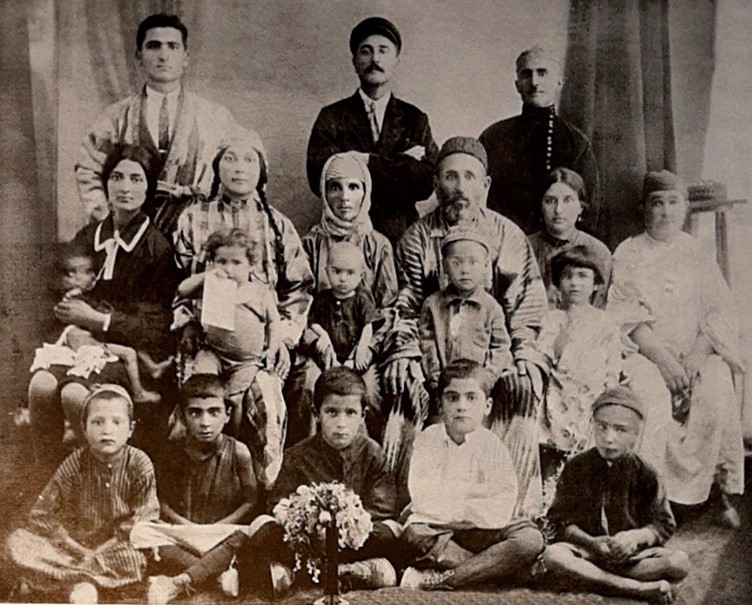
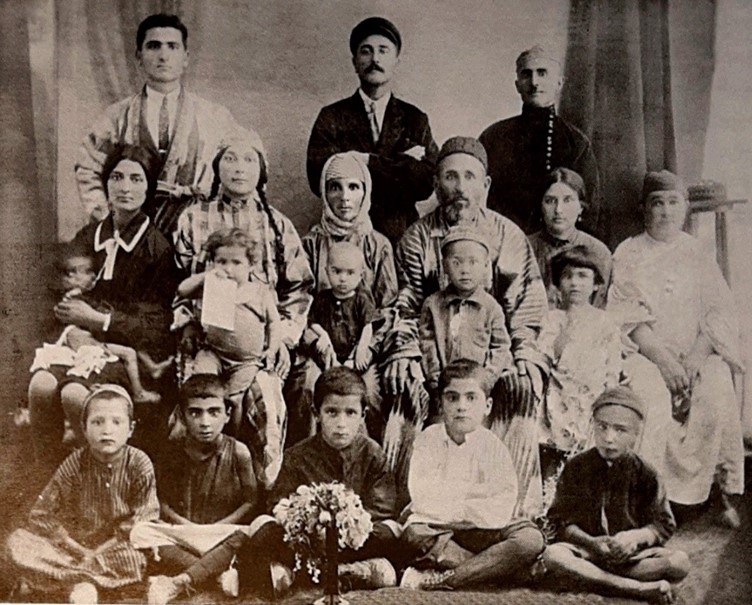
The Arabov family in Termiz (Uzbek SSR, 1930) - (Arabov 1998, 30).
Upper row (left to right): Mikhoel Arabov, Barukh, Ya’qūv Arabov.
Middle row (left to right): Miryam (wife of Mikhoel with her son), Hevsi (wife of Ya’qūv with Marusa), Rohel (with Nekqadam), Isroil (with Rotshild), Miryam (daughter of Rohel and Isroil with Zulay), Shirin Iskhaqov.
Front row (left to right): Nekqadam, ʾAliza, Ruben Arabov (with flowers), Khagay, Yusif Iskhaqov.
In 1929, the Soviet Union introduced the first Five-Year Plan. Trade and other forms of private enterprise were prohibited. At the same time, collectivization campaigns extended Soviet control from urban to rural areas. The economic situation in the Uzbek SSR deteriorated sharply. Food, including bread, was available only through ration cards, if at all. In 1932, Soviet authorities launched a campaign to accelerate industrialization and “build socialism.” Private property was confiscated on a massive scale. Among Bukharan Jews and Muslims, this campaign became known as tillogiri (lit. “taking the gold”).
These policies caused a mass exodus from Soviet Central Asia. It began in the late 1920s and continued until the southern borders with Iran and Afghanistan closed in the mid-1930s. Tajik historian Kamol Abdullaev estimates that nearly half a million Muslims – including Kazakhs, Turkmens, Tajiks, Uzbeks, and other groups – fled the region. Bukharan Jews were among these refugees. For them, emigration peaked in 1932 and 1933. When the borders became impassable, about 4,000 people – roughly one-tenth of the Bukharan Jewish population – had left the Soviet Union.
Stalin’s radical policies split the Jewish population into several camps. While some supported or believed in the Communist Party and its ideology, others remained indifferent or openly hostile to Soviet rhetoric. For most people, maintaining a normal life took priority – an increasingly difficult task as living conditions worsened and arbitrary arrests, along with persecution, became commonplace across the Soviet Union. These hardships drove many, Bukharan Jews, including members of the Arabov family, to risk escape.
One common escape route for Jews ran from Kerki across the Amu Darya through the desert to the Aqcha oasis in Afghanistan – a short but perilous journey:
Although the distance between the two border towns was not very great (some traffickers claimed it was 12–15, others 15–16 sang … one sang was about eight kilometres), for thousands this route became a dead end. Many ended up in prison, others in the sandy deserts. (Arabov 1998, 52)
Turkmen traffickers (rahguzaron, yūlchiho) typically guided refugees across the border. Yaʿqūv Arabov, Ruben’s elder brother, made the first attempts to find reliable guides from Kerki to Aqcha. He failed. At the end of 1932, Soviet border guards arrested him. His ten-year-old son, Hoji, accompanied him on this exploratory trip. Hoji managed to escape and returned safely to the family in Termiz.
Meanwhile, a wave of arrests hit the Jewish community in Termiz. Seventeen male members of the Arabov family, including Ruben’s brother Mikhoel, were detained and humiliated. They were later released through bribery. From then on, “the life and future of the whole family was hanging by a thread controlled by the secret police” (Arabov 1998, 40).
Despite all these dangers, further escape attempts were made. Ruben Arabov writes:
In those days, when all hope was lost, our father again begged Yaʿqūv to try once more and find a way out, for example, through Bayram-Ali (Arabov 1998, 54).
Like other towns in present-day southern Turkmenistan, Bayram-Ali had a sizeable Jewish community. However, Yaʿqūv was unfamiliar with this route and instead proposed traveling with a group of smugglers from Kerki. Such groups usually consisted of three or four horsemen who escorted one or two refugees. If intercepted, some traffickers would engage the border guards while others continued with the refugees. This method was extremely expensive. Yaʿqūv’s father agreed to the plan, and a week later Yaʿqūv departed. He reached Aqcha safely and sent word for his son Hoji to follow. The same trafficker escorted the boy, who also arrived safely.
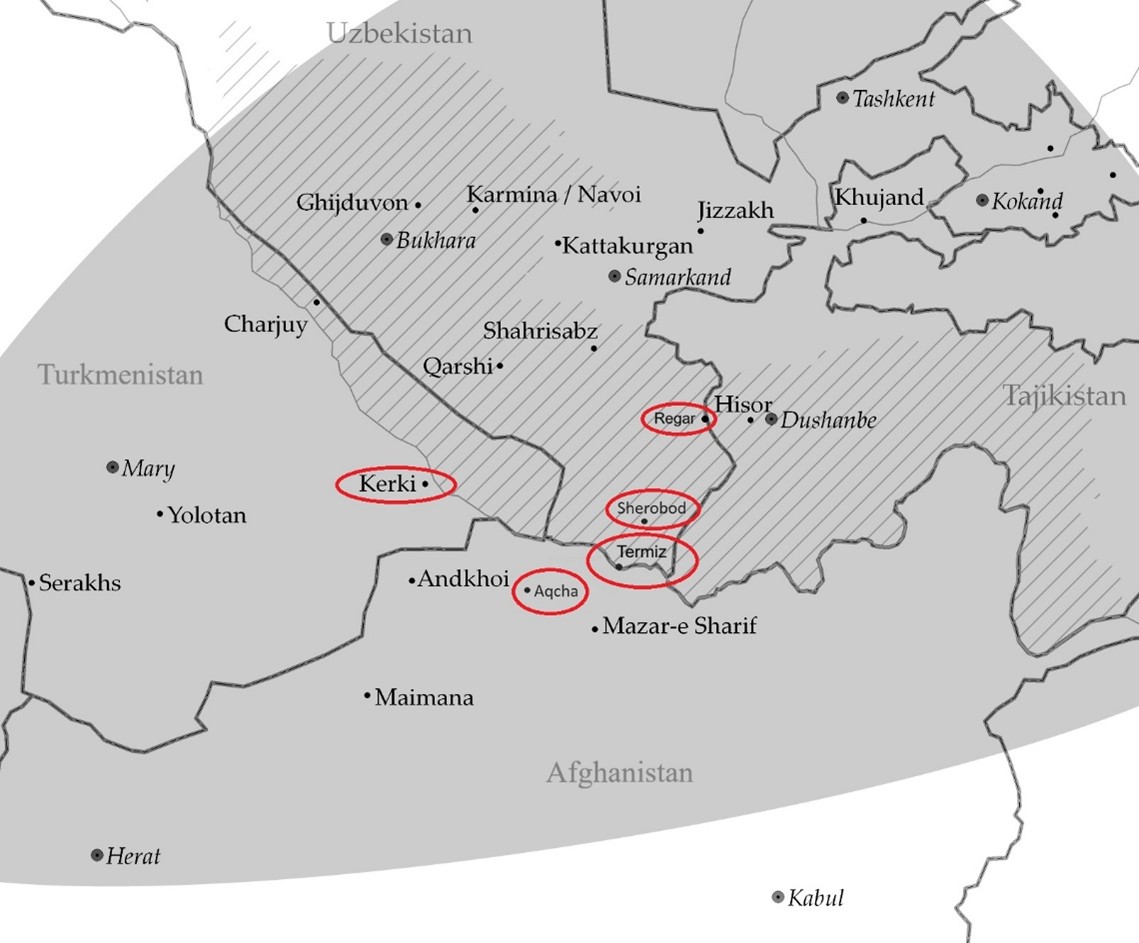
Map (detail): Soviet Central Asia and Afghanistan with towns mentioned in Ruben Arabov’s refugee story.
© Thomas Loy/Andrei Doerre/Jons Vukorep
Not all were as fortunate. After prison and property loss in 1933, Ruben’s brother Gavriel – once a fervent supporter of the Soviet Union – resolved to leave the country following the death of his six children. When he finally prepared to leave, his wife was pregnant again. His parents urged him to postpone the departure until his wife had given birth. Six months later, the family left for Kerki. Eleven days after departure, Gavriel returned alone and recounted the tragedy that had occurred:
When we arrived in Kerki, there was already a bunch of Jews from various Central Asian towns waiting and preparing for the border-crossing. We made acquaintance with a decent man from Shahrisabz (Elhonon Aminov). Four days later, we departed. One of the traffickers (yūlchi) prepared an opium-drink for the children to calm them down and make them sleep along the way. All children were two or three years old, except our six-month-old son, Malkiel. When they fell asleep, we put them on the bought donkeys and set out in the middle of the night.
The next morning, the three Turkmen [traffickers] left the group pretending to get new water for us. Hours passed, but these traitors did not return. We were lost in the sandy desert, running short of water under a burning sun. Having drunk the opium, my little son did not wake up again. His death increased our desperation. My wife started to rip out her hair. She cried for her beloved child. No one could console her. The whole group, relatives and strangers, couldn’t bear the desperate situation and the death of the innocent child. We all wailed in grief. But we were alone in this desert, and nobody would hear our wailing or come to help. The day turned night. Hoping to attract someone’s attention, we’ve burned parts of our clothes – without success …
Oybibish [the widow of Ruben’s deceased brother Betsalel] then took the underdress of Imo [Malkiel’s mother] and made a shroud (kafan) out of it. With their bare hands, Abo, Elhonon, and Ribikhay dug a hole in the desert sand. Then we buried the shroud with the unwashed body of the deceased boy in this desert grave … the third day in the desert came to its end. Then suddenly, out of nowhere, a horseman showed up with his rifle at the ready. He was from the border control. Shortly after, three more Red Army horsemen approached us. We asked them for permission to dig out the corpse of our son Malkiel and take him with us. But they refused. The next morning we were back in Kerki, and the Ashkenazi guy Ya’qūv had told us about took our animals and let us go (Arabov 1998, pages 55-56).
A few days later, Gavriel returned to Kerki and attempted the crossing again with his group. This time, they succeeded and reached Aqcha, where they reunited with Yaʿqūv. They waited for the rest of the family, but new arrests and the deteriorating health of the family patriarch, Isroel, prevented further departures (Arabov 1998, 57–59).
The Arabov brothers in Termiz maintained contact with refugees through Turkmen intermediaries, but communication ceased. Ruben later reflected the family’s separation: “Of our father Isroel’s large family, only Mikhoel, Hosid, Ruben, and a two-year-old grandchild remained in the USSR. Thus ended the winter of 1934–1935” (Arabov 1998, 62).
Yaʿqūv moved on and reached Palestine in 1934. Gavriel remained in Afghanistan until 1951, when he emigrated to Israel. The rest of the Arabov family remained trapped in the Soviet Union for nearly forty more years. In the 1970s, all of them left for Israel.
In summer 2018, I visited the “Sherobodi” synagogue in Tel Aviv, which was co-founded by members of the Arabov family in the 1970s. I was welcomed at the entrance by Igal Israelov, who was born in Israel in the 1950s. He showed us around. When I told him that I had read Avrohom Arab's family history and was wondering what he knew about the book and its author, Igal said that his uncle Ruben died a few years ago. He then opened a dusty cupboard in the synagogue’s office, took out a copy of the family story, opened it on page 203, and showed me his portrait there as a young Israeli soldier. With its many pictures in the Hebrew part, the book mainly serves now as a family photo album. “Unfortunatey, I cannot read Bukhori,” Igal told me in his strong Surkhandarjo dialect of Tajik dotted with a few Hebrew words. And he continued: “Most stories about the family’s past I know from my mother, who had fled from Central Asia in the early 1930s.”
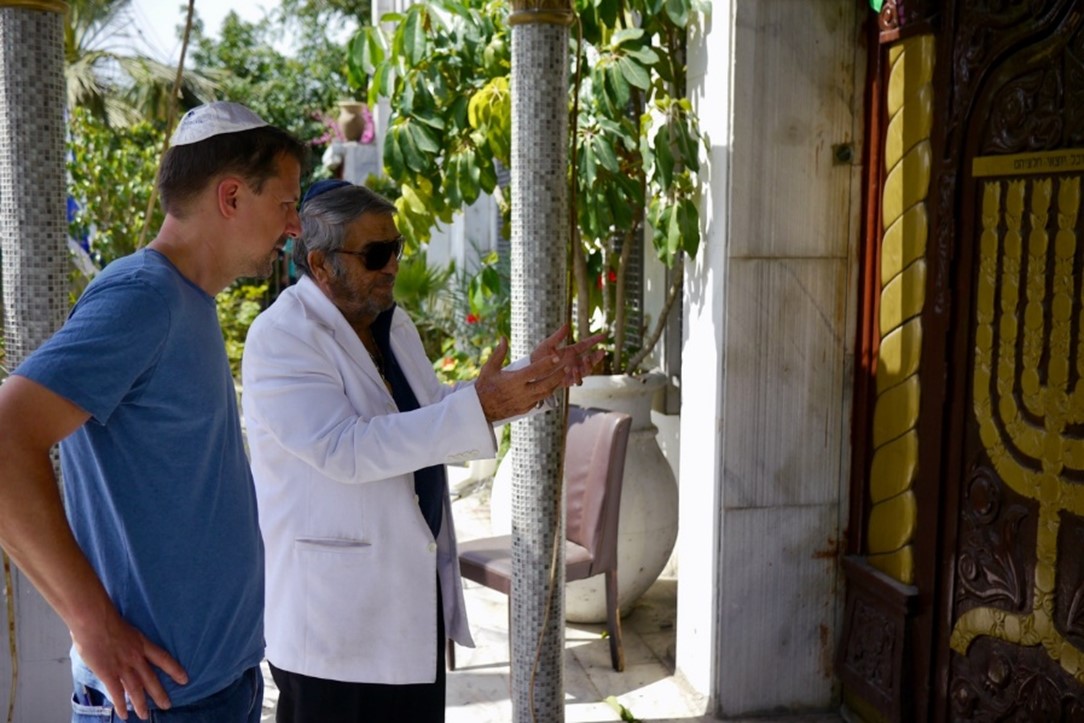
Author with Igal Israelov in front of the “Sherobodi”synagogue, Tel Aviv 2018 © Frank Henne/Thomas Loy
Written by By Thomas Loy