
Christoph Hopp
In October and November 1888, Shmuel Moshe Rivlin published a series of five reports from Bukhara in the Hebrew periodical ha-Melits, called “Letters from Bukhara.” Ha-Melits was issued six times a week in Saint Petersburg. It was part of the Hebrew press landscape that developed during the second and last third of the 19th century and helped to constitute a modern Jewish global consciousness. The newspaper’s name, ha-Melits “The Interpreter,” expresses this development. Following his letters, Rivlin back then lived in the Turkestanskii krai and functioned as a sort of foreign correspondent. There are other contributions of his to be found in that newspaper besides those letters, such as a description of a local Purim feast, which was sent from Kokand. Additionally, several reports by Rivlin were printed by the daily newspaper ha-Tsefira, which was published in Warsaw. There are to be found, both in ha-Melits and ha-Tsefira, not only letters written from and about places in Turkestan but also the Caucasus, such as Batum and Baku. More extensive research might thus be able to reconstruct Rivlin’s journey in fair detail.
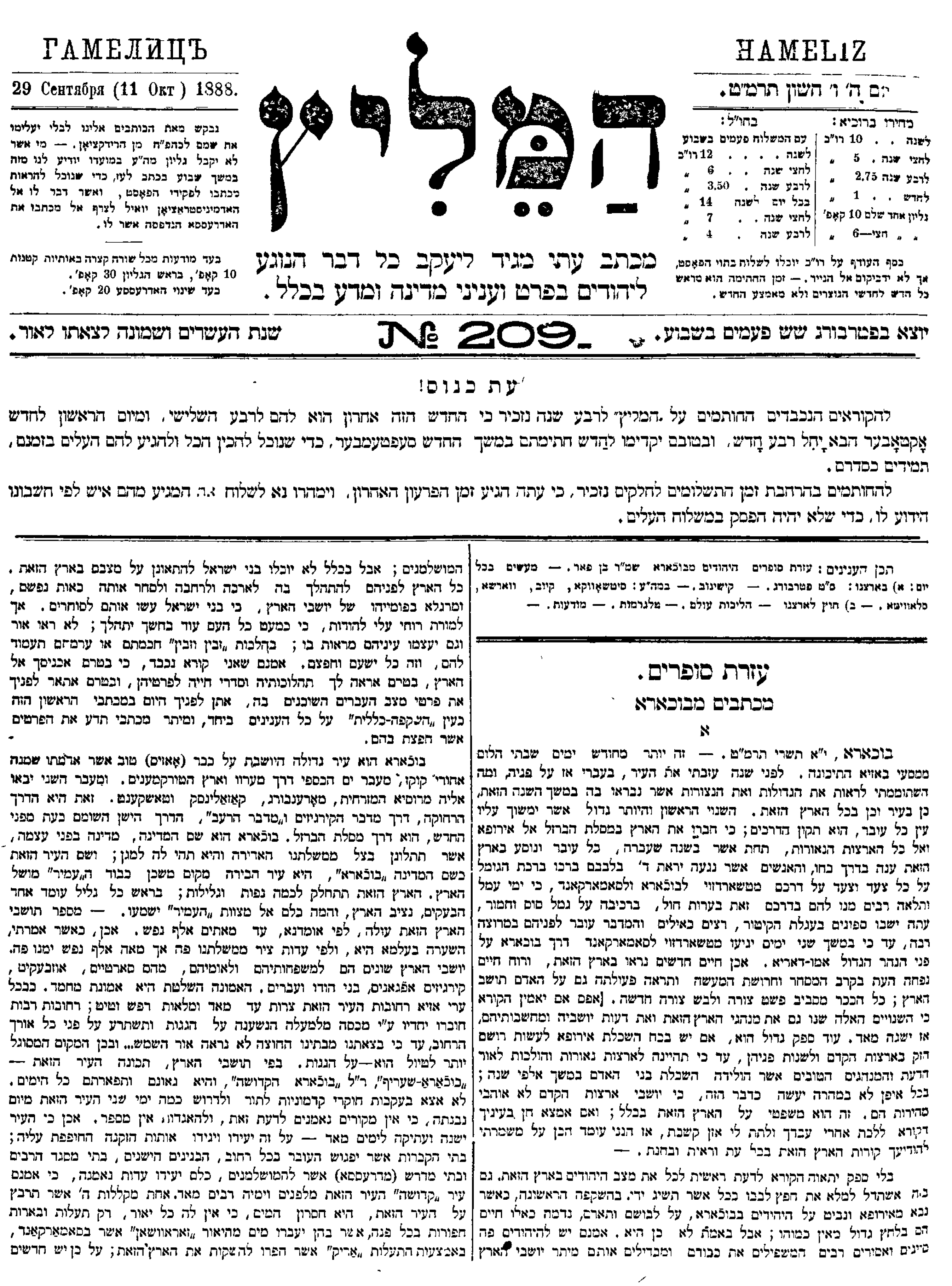
The first page of Ha-Melits from October 11, 1888, containing a part of Shmuel Moshe Rivlin’s first letter from Bukhara. The figure is taken from the Historical Jewish Press website www.jpress.org.il, established by the National Library of Israel and Tel Aviv University
Rivlin is an ambiguous observer. A common theme reoccurring in his letters is that of technological progress and enlightenment (ne’orut), which he deems to be at home in the West. His observations and documentary style of writing qualify Rivlin, his sometimes biased viewpoint and apparently deep-seated prejudices against the population of Central Asia notwithstanding, as one of the first historians of Central Asian Jewry. Concerning his style of writing, it is also worth noting that Rivlin tried to capture the sound between /a/ and /o/ typical for Central Asian Persian, by using a diacritic. He put a macron above the alef, which, without the macron, represents /a/. As will be seen below, he was not fixated on the life of his conationals, “our brethren,” as he wrote, but also showed interest in the region and its inhabitants as a whole. Jewish life is clearly in the focus, but here and there more general information are interspersed. The fifth letter is an exception in that it is almost exclusively dedicated to a description of Bukhara’s large Indian merchant community.
Rivlin was from Mogilev at the Dnieper, a town with a high percentage of Jewish inhabitants in the so-called Pale of Settlement; it was known for its maskilic inclinations. In the second letter, he tells his readers that during his childhood, a Bukharan rabbi, called Avraham Haim, came to Mogilev to study Thora there. He states that this happened twenty years ago. In that second letter, we can also read that Rivlin went on his first trip to Central Asia right after leaving his parents’ home. As one of his relatives, he mentions the name of Rabbi David Eidelman.
Rivlin’s predecessors and contemporaries
Rivlin belonged to a group of ethnographically interested travelers, journalists, and scholars who pioneered the documentation of Jewish life in Central Asia; as Rivlin, many of them were Jews themselves. With the rapid development of the press and the accelerating transmission of information during the second half of the 19th century, Central Asian Jewry, and Bukharan Jewry in particular, frequently appeared in the Western Jewish world of letters. The Damascus Affair of 1840 mobilized the Jews of the West and is generally held to be the foundational moment of international Jewish diplomacy, that eventually led to the establishment of the Alliance Israélite Universelle in 1860. That Khorasan/Central Asia had not yet entered the globalized Jewish consciousness is evident from the fact that the persecution and forced conversion of the Jews of Mashhad in 1839 was little known in Europe. A striking instance of the change that occurred in the perception of Central Asia and its Jewish population in the subsequent decades is the travelogue (stuffed with historiography) by the Romanian-Jewish explorer Israel Joseph Benjamin. His journey through the East brought him, among other places, to Kashan, Isfahan, Kabul and Bombay, where he got into contact with Jews from Bukhara. The Bukharan Jew he met in Bombay told him that around 2500 Jewish families are to be found in Bukhara and the surrounding area, making a living from trading, agriculture, and handicrafts. Between 1858 and 1860, this section of the travelogue was published three times. In 1858, the entire travelogue was published in German. In 1859, an English edition came out, while that section was published separately in March 1860, this time in Italian in the monthly L’Educatore Israelita (issue 8). Benjamin also mentioned the forced conversion of the Jews of Mashhad. In 1865, Arminius Vámbéry published the travelogue of his journey across Central Asia. Besides some notes, it contains a single consecutive passage on the Jews in the Khanate of Bukhara. This passage was reprinted twice in The Jewish Chronicle (18.05.1866, 22.03.1867). After the Russian conquest of Central Asia, the publications in Hebrew and other languages became more common. In 1880, an interesting correspondence signed with the name “Moshe Ben Yosef called Harrison” was published in the Hebrew weekly ha-Maggid (30.09.1880). There are strong indications that the text is not a translation but originally written in Hebrew (back then, Hebrew periodicals regularly republished translations from other Jewish newspapers). Harrison, writing from Calcutta, reports that, a few weeks ago while staying in Balkh, a Jewish caravan from Bukhara arrived in the city, accompanied by two hundred armored and sturdy men. All of them Jewish too. They came to trade, and as they had to cross Turkmen territory, they could not do without this escort. Harrison begins his report, which includes other details concerning the Jews of Bukhara and Afghanistan, by admonishing the generally meager knowledge about Central Asian Jewry. The Jewish German language periodical Der Israelit likewise had its own correspondents in Central Asia, amongst whom apparently was at least one native, namely of Khiva (see the issues of May 2 and 9, 1887). In 1885, Henry Lansdell published his voluminous Russian Central Asia including Kuldja, Bokhara, Khiva and Merv, which contains a lot of information about Jewish life. The same year, the book was translated into German, while it took five years that two sections, on Samarkand and Bukhara, were reprinted in the Allgemeine Zeitung des Judenthums (18.12.1890, 25.12.1890). Moreover, articles on Central Asian Jewry were published in the Jewish Russian language periodicals Rassvet and Voskhod. In the latter’s weekly supplement, Nedel’naya khronika voskhoda, Rivlin had published two short reports on the Jews of Kokand and Samarkand (issues 2 and 35 of 1888, respectively). Between 1883 and 1886, Ephraim Neumark travelled from the Galilee to Greater Syria, Mesopotamia, Persia, and eventually Khorasan, Transoxania, and Khwarazm. His informative travelogue of thirty-six densely printed pages was published in Nahum Sokolow’s yearbook ha-Asif in Warsaw in 1889. Neumark was born in Lakhva (in today’s Belarus) in 1860 but migrated to Jerusalem and then Tiberias in the early 1880s. His travelogue became an often-quoted primary source for Hebrew scholarship on the history of Central Asian Jewry, as it developed in Eretz Israel/Palestine and, later, the State of Israel over the past century. Avraham Ya’ari published an edited version of the text, accompanied by an introduction and explicatory footnotes, in Jerusalem in 1947.
There are some significant incongruities between all these 19th-century accounts, and it may be worthwhile to compare the data. A blatant contradiction we have concerning Khiva, as Neumark claimed that except for two Jewish apostates from Bukhara, no Jews were living there. He even ridiculed other newspapers for spreading fraudulent second-hand knowledge about the Jewish community of Khiva, but did not mention the reports published in Der Israelit. Yet, these reports contain lively and detailed descriptions of Jewish life in Khiva so that one must wonder how the extreme contradiction came about (Lansdell does not provide us with decisive information).
This list of sources presented above is far from being exhaustive. It seems to me that mining the many contemporaneous Hebrew (but also German, Russian, etc.) periodicals would be a promising way to shed further light on the 19th-century history of Central Asian Jewry.
Rivlin’s letters from Bukhara
In the following, I summarize the first of Rivlin’s letters, dated September 16, 1888, leaving detailed assessment and commentary aside for the moment. It was published in ha-Melits about a month later, on October 11. The remaining letters will be summarized in subsequent blog posts. The basic data are the following: The second letter was written during Sukkot of 1888 and published on October 14 that same year. Its main theme is the relationship between the Jews of Bukhara and Russia; the largest section is on trade and economy. The third letter was published on October 15. It discusses the problem of swindlers who come to Central Asia and pose as emissaries or wise men from Jerusalem in order to extort money from local Jews. Additionally, it reports an apparently antisemitic incident that happened in a train from the Caspian Sea toward Bukhara, and touches upon the relationship between the Ashkenazic Jews and the indigenous Jews in Bukhara. The fourth letter was written on October 20, but not published until November 26. It lengthily describes a visit of Edmond James de Rothschild and his spouse, Adelheid, to Samarkand and Bukhara. The fifth letter was written on October 24 and published on November 28. It refers yet another brief impression of the Rothschild visit before proceeding with, as already mentioned, a description of the Indian community of Bukhara.
The first letter
With the construction of the Transcaspian railway line, which started in 1880, traveling from Europe to Central Asia was to become much more convenient. While Russia wanted to fasten its grip on the territories it had conquered from 1860 onward, the railway also accelerated the economic and intellectual exchange between the regions. Rivlin begins his first letter by praising this improvement of infrastructure: Central Asia (this name for the region is also in use in Hebrew, asya ha-tikhona) is now connected to Europe and every enlightened country, thanks to the new railroad leading from Chardzhou (Türkmenabat) to Bukhara and Samarkand. It allows one to circumvent the arduous Kazakh desert, the “desert of starvation.” Every god-fearing person blesses the invention. At the same time, Rivlin dampened overly high expectations: If Central Asia were eventually to undergo a broad process of European-like modernization in terms of both material and cultural life, it would be a slow one, “for the people of the East do not love rapidity.” Interestingly, it was out of question for Rivlin that Russia is part of the Western hemisphere.
Following Rivlin, Bukhara is inhabited by “Sarts, Uzbeks, Kirgiz (= Kazakhs, as Rivlin follows the Russian terminology of the time), Afghans, Indians, and Jews (ivrim).” The antiquity of “Bukhoro-sherif,” which he translates for his readership as Bukhara ha-qedosha, “Holy Bukhara,” is attested to by its old cemeteries, mosques, and madrasas. One of the “curses” by which the city is hit hard, is the lack of water. Through dug canals (ariq) water is channeled to Bukhara from the Zarafshan River. If such a canal is clogged for whatever reason, it can happen that the people get bone-thirsty, “their tongues sticking to their palates.” As the water sometimes remains in the wells for months, the latter become the source of various dreadful diseases.
Rivlin estimates that about five thousand Jews are living in the city of Bukhara. “Their language is the language of the city, the stammerers’ language [lashon ha-ilgim], a corrupted branch of the Persian trunk. A few also know to read Hebrew.” With lashon ha-ilgim Rivlin apparently adapted the equivalent Arabic term al-lisan al-ajami, which is a derogatory term for the Persian language and its speakers. Many Jews in Bukhara accrued a considerable amount of capital, although this did not keep them from complaining about their living conditions. Trading and making money are everything that both the poor and the rich care about. They even do business in the realms of almsgiving and legal affairs. The most fundamental problem afflicting the Jews of Bukhara and their morals was their complete lack of leadership and communal institutions such as schools and welfare organizations. Rabbi Haim ha-Cohen and some other wise and enlightened men, of whom Rivlin mentions only one by name (see below), are in his few exceptions from the rule. He criticizes that the children, both boys and girls, are poorly educated, and that nobody is interested in improving this situation. He sums up his aversion in a local proverb, which uses the Hebrew-Jewish concept of “exile” (galut): “Galut is the galut that is in our fetuses [literally “fetus”]” (Ha-galut ha-galut be-ubarenu).
In Rivlin’s view, the Jews of Bukhara live under the “Muslim yoke” denying them the right to enlightenment. Only the Indian minority, as described by Rivlin in his fifth letter, has to cope with equally miserable conditions. Rivlin mentions some of the humiliating restrictions imposed on Jews in public spaces. Of these, the ban on wearing silk clothes and greeting Muslims with the customary “Peace be upon you!” seem particularly noteworthy to me, as they are less well known than others cited in many historical works on the Jews of Bukhara. According to Neumark, Jews were allowed to wear silk clothes. Rivlin commented that the people in Bukhara are very punctilious in these matters, even though their own economic well-being does not depend on them in any sense. Yet, the individual Muslim, he specified, is not responsible for these deplorable conditions. They have structural causes which individuals are not able to alter. With regard to the authorities’ arbitrary taxing, he remarked that while Jews have to pay five percent taxes on their income, the rest of the people, including European immigrants, have to pay only two and a half percent. Most of the Jews became accustomed to their inferior status.
Not more than a handful of brave men assumed the task of spreading “wisdom and understanding” amongst the people. One of these men is Rabbi Shlomo Ben Yaakov Mussoyeff, who “loves the new Hebrew literature” and founded a Talmud Torah for the poor a year ago. Thus Rivlin concluded the first of his letters from Bukhara.