
The Forgotten Grave: Payrav Sulaymoni and the Untold Stories of Jewish Converts in Central Asia
On June 9, 1933, the famous Tajik literary figure Payrav (Otajon) Sulaymoni died of typhoid fever in Samarkand. He left behind two daughters. His burial site is located within the grounds of Shah-i Zinda, one of Central Asia’s most well-known and largest necropolises.
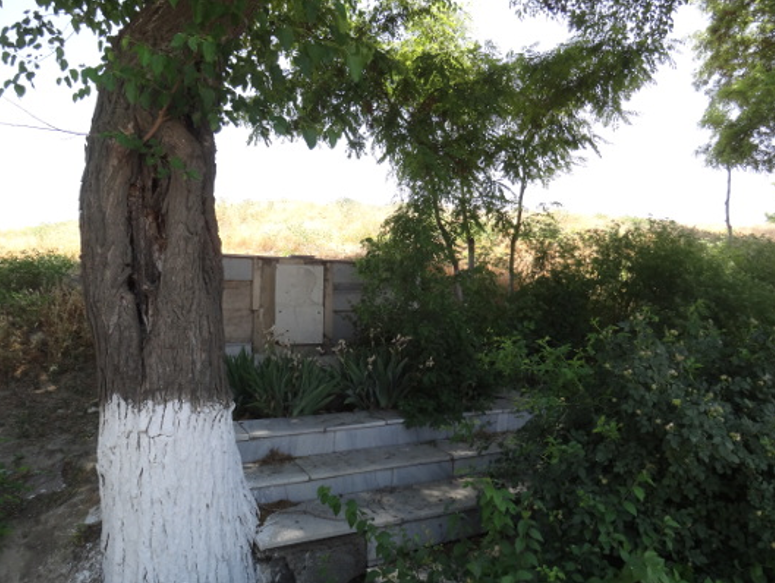
Payrav Sulaymoni’s grave (Samarkand, 2014) – photo: Massoud Hosseinipour
If you set out to find Sulaymoni’s grave, you’ll hardly be able to locate it in the several-hectare cemetery. There are no signs, and for some years now, a road (the Toshkent yo‘li) has cut off the northern part of the cemetery from a burial field that once belonged to the necropolis. One of the graves in that area is that of Payrav Sulaymoni. Even in 1933, it lay at the outskirts of a cemetery that had not yet been fully used. What were and what are the reasons for this neglect of a poet who is still known and honoured in Tajikistan as one of the founders and greatest poets of Soviet Tajik literature?
When Massoud Hosseinipour visited the grave of Payrav Sulaymoni in Samarkand in 2014, he wrote:
The gravesite, built during the Soviet era, now appears neglected and run-down. Apparently, no one has taken care of it for a long time. The back of the grave is formed by a roughly one-meter-high, three-part concrete wall that was once covered with gray marble slabs. A relief of Payrav Sulaymoni used to adorn the central section of the wall. About half of the marble slabs have come loose from the base wall. Some of them have been propped up against the grave wall. One of these slabs has a peace dove engraved on it. In Arabic script, it reads: 'Otajon Payrav Sulaymoni, Bukhara 1899, Samarkand 1933.' A second slab carries the same information in Cyrillic script.
In front of the back wall of the grave is a stepped enclosure. Within it lies an open book carved from stone. On its half-overgrown pages, a Persian verse in Cyrillic script is inscribed along with its Russian translation, taken from Payrav Sulaymoni’s poem Qalam (“The Pen”):
To jahon hast, zinda xoham bud As long as the world stands, I too shall live
Qalamam umri javidoni man ast. This writing pen is my eternal life.
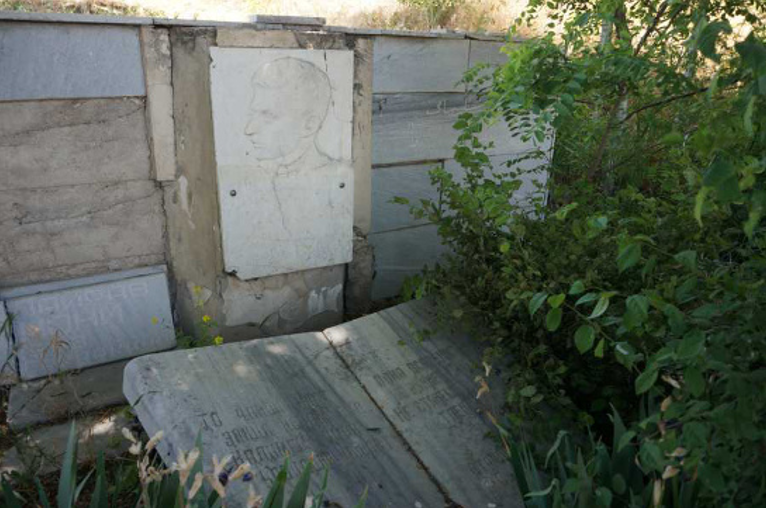
Payrav’s grave with his portrait and the open book (Samarkand, 2014) – photo: Massoud Hosseinipour
Otajon Sulaymoni’s life was short. It unfolded at a time of upheaval and transition from the old to the new Central Asia. In one of the most convincing descriptions of Payrav Sulaymoni’s writings Keith Hitchins wrote that “his poetry endures as the reflection of a world caught in motion between two eras.”[I]At the beginning of the 20th century, a movement of enlightened Muslims emerged in the Emirate of Bukhara (as it did across much of the Islamic world). Their aim was to reform the old, entrenched structures and to strengthen their society through religion to face the challenges of a new era shaped by capitalism, imperialism, and industrialization. After almost half a century of rule in Central Asia, the Russian Empire was about to collapse.
Otajon Sulaymoni received a traditional Muslim education, along with private instruction from a Russian tutor in Bukhara. At just under twenty-one years of age, Otajon witnessed the attack of the Red Army, the expulsion of the Emir, and the transformation of his homeland, Bukhara, from an “emirate” into a “people’s republic,” and just four years later, its dissolution and incorporation into the newly founded Soviet Republic of Uzbekistan.
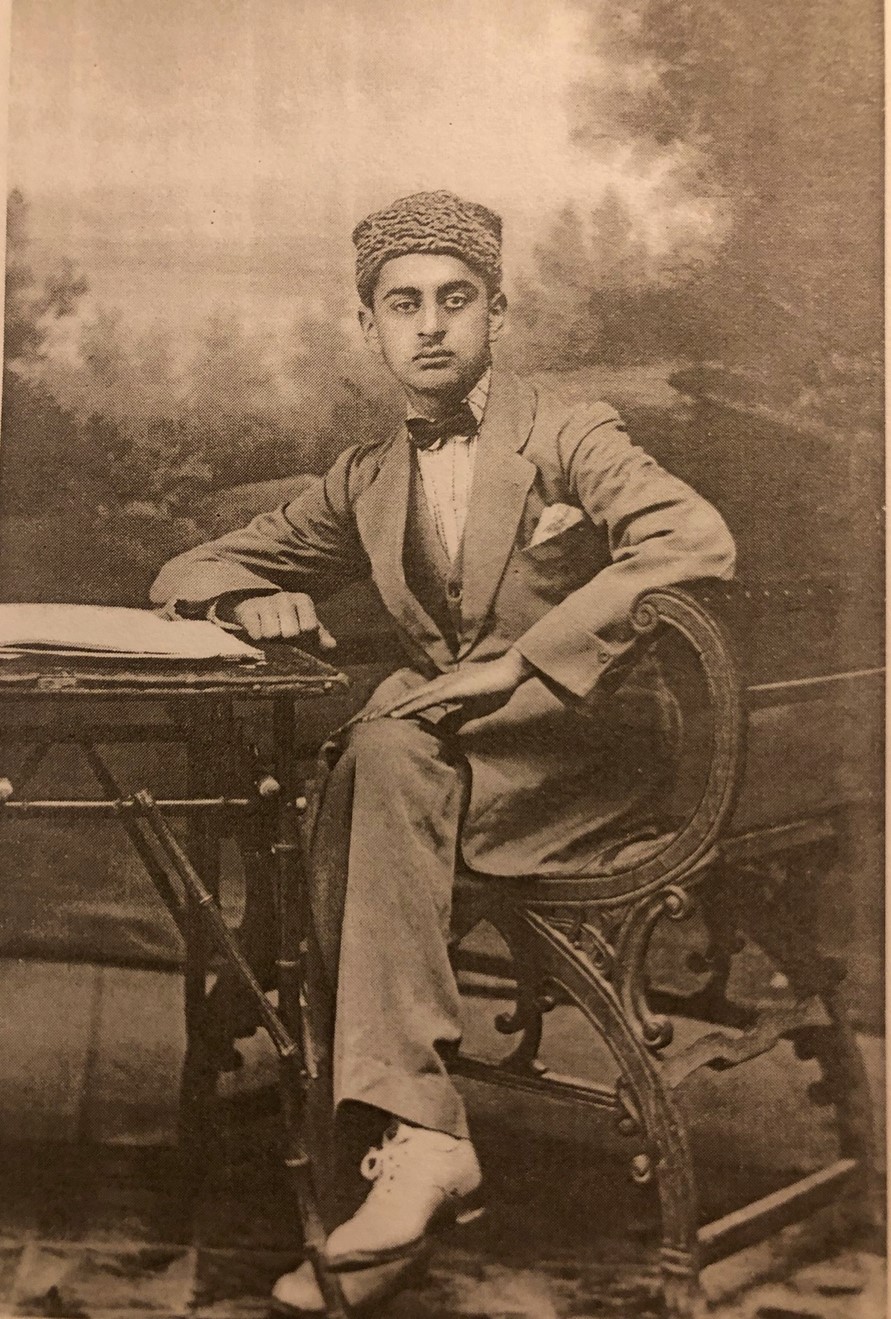
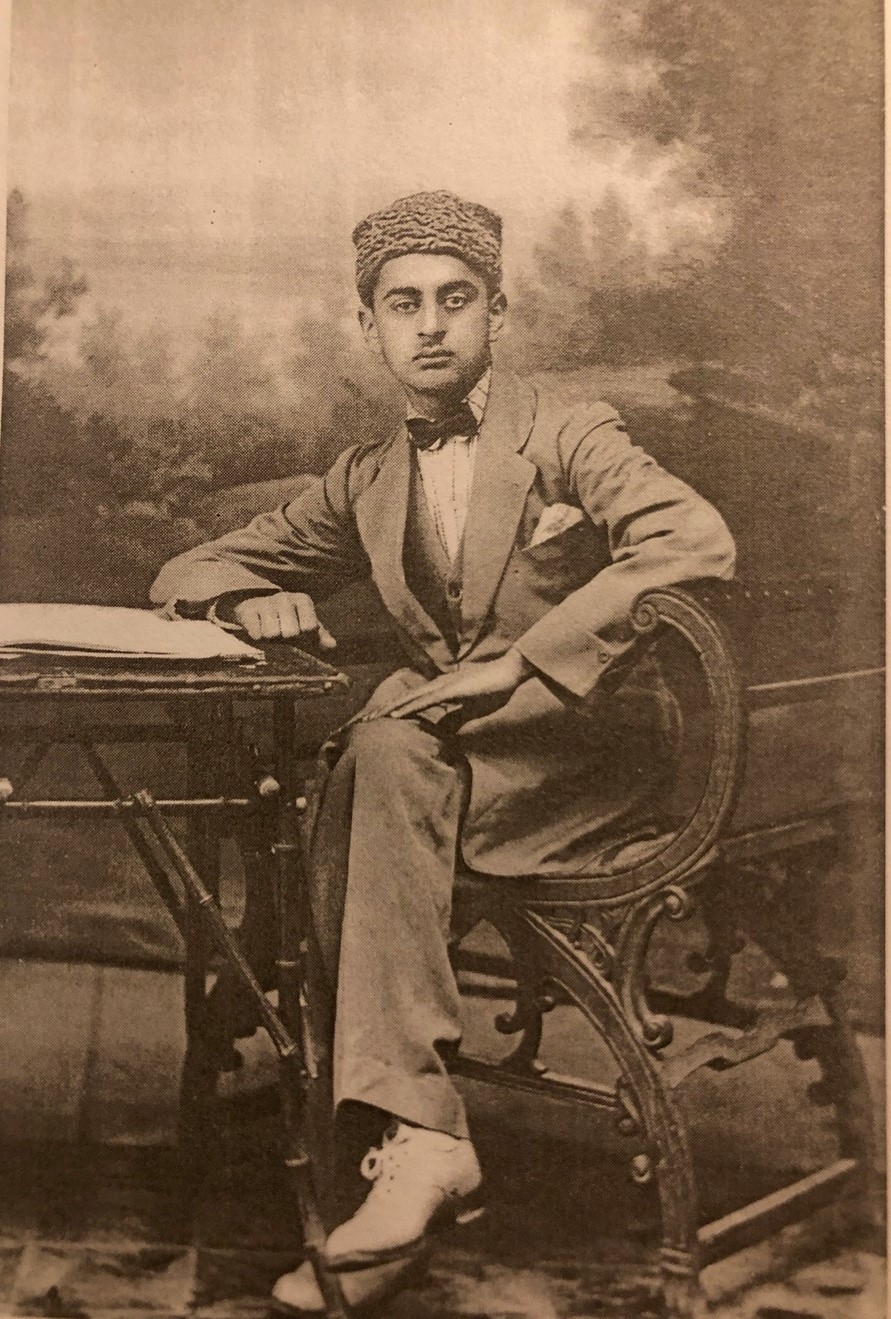
Payrav Sulaymoni 1918 (photo taken from Payrav Sulaymoni: Kulliyot. Dushanbe, 2006)
By that time, he had already moved well beyond his early literary experiments. He began composing poetry in 1916 under the pen name Payrav (“The Follower”). At that time, he attended a Russian school in Kogon, the Russian town south-east of Bukhara. In 1921 and 1922, he accompanied his uncle, who was appointed ambassador of the Bukhara People's Republic to Kabul. Otajon Sulaymoni acted as the embassy’s second secretary and also visited Persia. After returning to Central Asia, he became active as a journalist, editor, and translator for the Tajik State Publishing House. For most of the 1920s, he lived in Bukhara and Samarkand.
His first poem published in a Soviet newspaper was Shukūfa-i irfān yā khud āzādī-i zanān-i sharq (“The Blossom of Enlightenment, or the Emancipation of the Women of the East”), which appeared in Āvāz-i Tājīk on November 28, 1926. In his anthology Tajik Literature (Namūna-i adabiyāt-i tājīk) – which was also published in 1926 but pulled from circulation shortly after its release – Sadriddin Ayni described Payrav as a passionate and outstanding young poet:
He composes love poetry from the bottom of his heart... He has also recited revolutionary poetry... The garden of new Tajik literature awaits to thrive on the water flowing from his poetic genius.[II]
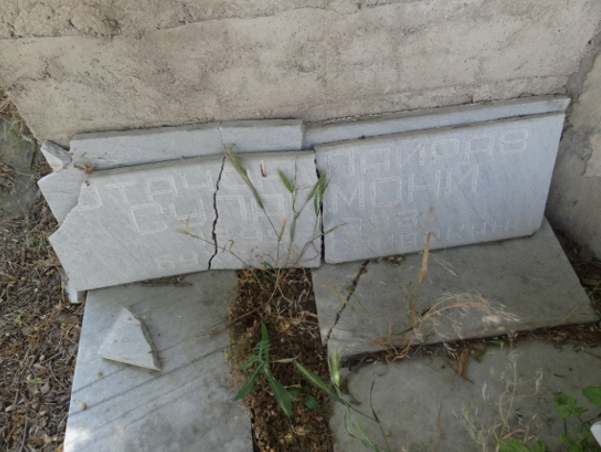
Fallen marble slabs with the poet’s name – Photo by Massoud Hosseinipour (2014)
But just a few years later, under Stalin, Soviet aesthetics and politics shifted dramatically. And when Payrav finally published his first poetry collection Shukūfa-i adabiyāt (Blossoms of Literature) in 1931, his writings faced severe criticism, and he was attacked and denounced as a counterrevolutionary and a chauvinist. (See my entry on Bektosh and his introduction to Payrav Sulaymoni’s Shukūfa-i adabiyāt in Literary Modernity in the Persophone Realm, pp. 313–328.
In the same year (1931 or 1932), Payrav Sulaymoni wrote an open letter to the magazine Tojikiston-i Surkh (Red Tajikistan). In it, he protested the false accusations and revealed his origins, which were apparently also made against him.
First of all, I would like to admit that I have never and nowhere concealed my social background, and I am going to repeat it here in short: I was born in Bukhara in 1899 as a son of one of the town’s (rich) traders. My father's grandfather was one of the so-called Jadīd al-Islām from Mashhad. In Iran, they were working as pharmacists (attori) and physicians (hakimi). That’s why their nickname (laqab) was hakimi. During the “killing the Jews”-pogrom in Iran, about 130 years ago, he and his brothers became Muslims and escaped from Iran and came to Marv in the Transcaspian region, what is nowadays Turkmenistan. There, one of these brothers married a Turkmen nomad girl from the Ersary tribe. Thirty or forty years later, their children came to Bukhara for trading. There they married with local Tajiks and settled.[III]
Presumably, Otajon Sulaymoni here refers to a pogrom and the subsequent forced conversion of the Jewish community, which had happened not 130 but around 90 years earlier in Mashhad in 1839.[IV] Like many other Mashhadi Jewish families who became known as Jadid-al Islam (New Muslims), Otajon Sulaymoni’s ancestors left the city and settled in neighboring Herat or other towns with Jewish communities in Central Asia. Some led lives as crypto Jews (outwardly Muslim but strictly Jewish at home) and retained their specific group identity. Others, like the Sulaymonis, integrated into Muslim society.
In Russian Turkestan, Otajon Sulaymoni’s father, Abdukarimjon, like many other Mashhadi Jews, engaged in cross-regional trading between Russia, the Bukharan Emirate, Afghanistan, and Iran. From 1911 to 1914, his son received a Muslim education in Marv. From 1914 to 1916, he had a private teacher for Russian and from 1916 until the failed Kolesov campaign on Bukhara in March 1918, he studied in a Russian language school in Kogon. Early on in Bukhara, the Sulaymoni family engaged with the Saidjonov family (a story that we started to research on during this project). In the 1910s, Musojon Saidjonov and his brothers were part of the Young Bukharan reformist movement. In the 1920s and 1930s, they were active in Soviet politics. At the end of the decade, like most of the pre-Soviet intellectuals, they were executed by the system they helped to create.
Payrav’s early death from illness in June 1933 spared him that fate. But his family history was still subjected to violence. For reasons unknown, he never finished or sent the letter, intended as a self-defence. It was only in 1959, in an anthology of his poetry and prose edited by his daughter Lola, on what would have been his 60th birthday, that the letter finally reached the literary public.
However, in later publications, the part of the letter dealing with Payrav Sulaymoni’s Jewish family background was omitted. From the 1960s on, the heavy critique and the problems Payrav Sulaymoni faced after the publication of his first anthology of poems in 1930 are also not mentioned. References to Payrav Sulaymoni’s Mashhadi Jewish background were already absent in the most detailed research on the poet, which was published in Dushanbe in 1962 by Sohib Tabarov.[V] This did not change in post-Soviet Tajikistan.
In 2006, when Payrav Sulaymoni’s collected works were published in Dushanbe, his open letter was also included. Yet the part in which he describes his Mashhadi Jewish family background (the part cited above) was carefully removed from this autobiographical text, as if it had never existed.[VI] Silencing the Jewish past of Payrav Sulaymoni’s family history was so successful that even in the Encyclopedia Iranica article on Payrav Sulaymoni “the Tajik poet who blended the classical traditions of Tajik-Persian verse with the social themes of the new Soviet Central Asia of the 1920s and early 1930s” we do not read a single word about it (accessed 29/07/2025).
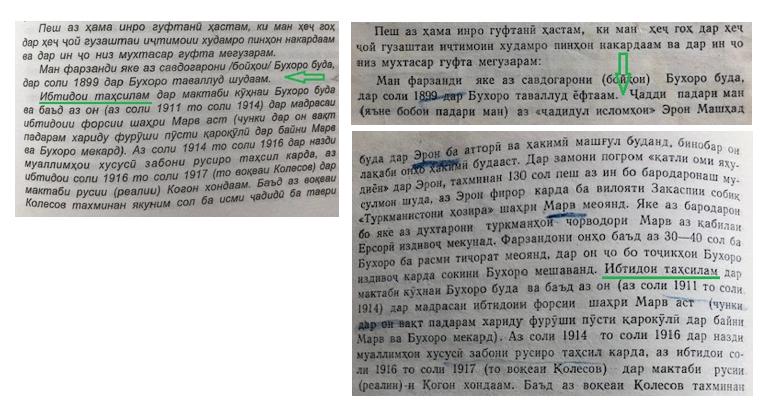
Payrav Sulaymoni's open letter (the part where he writes about his family background) as published in Tajikistan in 2006 (left) and 1959 (right). The green tags mark the beginning and end of the omission.
Fully Tajikizised and celebrated in Tajikistan, on the other side of the border, in Uzbekistan, as we saw at the beginning, the memory and legacy of Payrav Sulaymoni were not preserved at all. There, the poet was ignored for two reasons: first, because he was considered a Tajik (a stain in Uzbekistan that is only slowly removed under the new presidency of Shavkat Mirziyoyev), and second, likely also because of his Jewish roots. However, silencing and ignoring the multilayered and complex multiethnic Central Asian past is not just a problem for the self-image of Muslims, Tajiks, and Uzbeks.
Stories of border-crossings and rather fluid identities like the one of Payrav Sulaimoni’s family are also largely ignored by the Central Asian Jews. While the topic of forced conversion under the rule of the Emirs of Bukhara is a genre of its own in Bukharan Jewish memory and folklore, the destiny and the history of Jewish-Muslim families remain excluded from the Jewish community and memory. It seems that these stories do not fit into the self-image of either Tajiks or Jews.
In historical sources of the Russian Empire, this group was referred to as Jewish Muslims (everei-musulmane). In Central Asia, they were (and are) known as chala—a rather derogatory term meaning “half-breed” or “neither this nor that,” which quite accurately describes their liminal and marginalized status in-between. Stories – albeit often less well-known than that of Payrav Sulaymoni – that challenge the old religious and new national boundaries and identities continue to exist in both Uzbekistan and Tajikistan. They are still waiting to be told.
In her groundbreaking study of Bukhara in the late 19th and early 20th centuries, Olga Sukhareva (1966) described the status and history of the Chala in great detail. Her historical-ethnographic research also showed that the marginalization of this group in Central Asia continued even after 30 years of Soviet rule. To this day, the identity of the Chala is shaped more by external labelling than by open self-attribution (Payrav’s unsent open letter is a typical example). In cities like Bukhara, Samarkand, and Dushanbe, knowledge of the Chala past of individuals or families is often treated as an open secret. Rumours about their Jewish roots and past persist.
Recently, sitting in my office in Ladví, I stumbled across one of these stories. Mubinjon Tajiev, a former sprinter on the Soviet national track and field team, told it to Stefan Applis, a German geographer, who worked in Bukhara in the 2000s and 2010s and wrote about it in a blog. Mubinjon was born in Bukhara in 1936, three years after Payrav Sulaymoni’s death, and passed away there in April 2020. In a conversation with Stefan Applis (accessed 28/07/2025), Mubinjon Tajiev mentioned – almost in passing – his Mashhadi Jewish family background:
10.4 seconds on 100 meters and ‘Finish’! You can’t imagine how exceptional it was back then. A sprinter from Uzbekistan! I wasn’t as fast as Valeriy Borzov had been, but of course, we didn’t have the training facilities like the athletes from Moscow. I was simply fast — a fast Tajik from the Uzbek Soviet Socialist Republic, the fastest man from Central Asia. Actually, we were Jewish Persians, but Stalin had decided that we were Tajiks, so we were Tajiks. I was a Soviet Tajik who won medal after medal. Start, sprint and finish. 1979 was my most successful year.
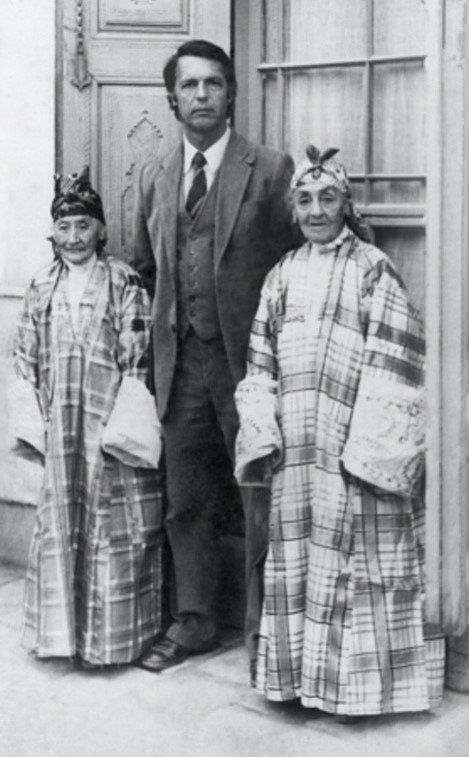
Mubinjon Tajiev in the 1970s – the successful sportsman with his mother on the right side (Photo by Shavkat Boltaev (1957-2022)
A few days ago, a colleague and friend who had just returned from Samarkand told me that Payrav's tomb at the cemetery in Samarkand was recently renovated at the initiative of a group from Tajikistan. As soon as I have a photo of the tomb and more information about it, I will post it here.
Thomas Loy (08.08.2025)
(I would like to thank Massoud Hossainipour for the photos and for locating the grave of Payrav Sulaymoni. The first part of this post is partly based on his contribution on http://www.tethys.caoss.org/das-von-grab-payrav-sulaymoni/ accessed 28/07/2025)
-----
[I] Keith Hitchins: “Tajik Literature.” In Persian Literature from outside Iran. Edited by John R. Perry. A History of Persian Literature,Vol. IX, 296.
[II] Ṣadr al-Dīn ʿAinī: Namūna-i adabiyāt-i tājīk. Moscow, 1926. First edition in Cyrillic script: Namuna-i adabiyot-i tojik. Edited by Kamoluddin Aini and Nizom Qosim. Dushanbe, 2010.
[III] Payrav darbora-i khudash (“Payrav about himself”), in: Payrav Sulaymoni: Majmua-i osor. Edited by Lola Sulaymoni. Stalinobod, 1959, 23–24. This translation was first published in Thomas Loy: Bukharan Jews in the Soviet Union. Autobiographical Narrations of Mobility, Continuity and Change. Wiesbaden, 2016, 130–131.
[IV] On the Mashhadi Jews and their forced conversion, see for example Raphael Patai, Jadīd al-Islām. The Jewish “New Muslims” of Meshhed, Detroit, 1997 and Jaleh Pirnazar, “The Anusim of Mashhad” in Esther’s Children. A Portrait of Iranian Jews. Edited by Houman Sarshar. Beverly Hills, 2002, 115–136.
[V] Sohib Tabarov: Očerki hayot va ejodiyot. Dushanbe, 1962.
[VI] Payrav Sulaymoni: Kulliyot. Edited by Muhammadjon Shakuri et al. Dushanbe, 2006. See also Thomas Loy op. cit.