
Thomas Loy (25-01-2026)
In 2004, I began my PhD project on the history of the Bukharan Jews. A year later, I visited Samarkand and made the acquaintance of Nina Ishaqova and her husband, Boris. The Bukharan Jewish couple lived in a courtyard in the Russian part of the city, founded in the second half of the 19th century (after the Russian conquest), and rented out some of their rooms, which had been unused since their children left for Israel. They took me in and cared for me like parents.
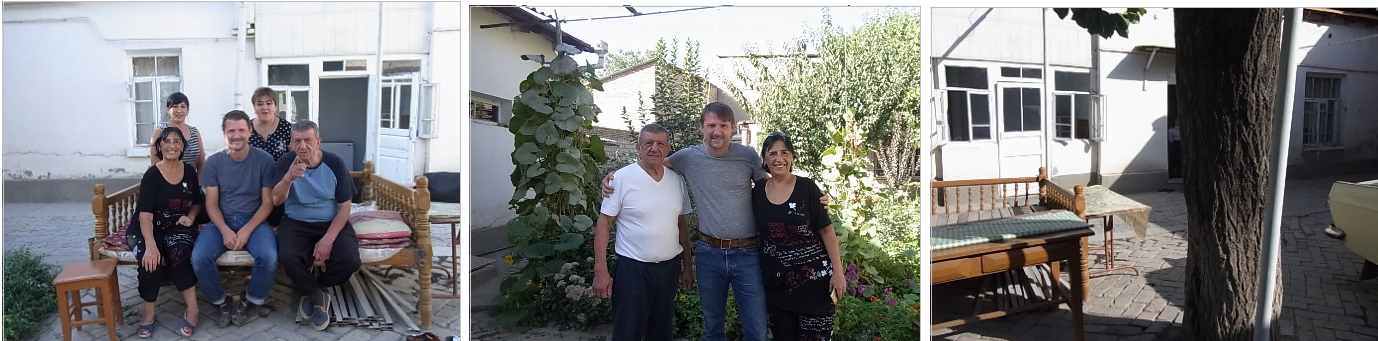 With Nina and Boris in their courtyard, all pictures © by the author, Samarkand 2018
I told them I was interested in the history of Bukharan Jews during Soviet times. Nina and Boris immediately recommended I meet and talk to Arkadi Il'yasov, who “knows most about historical things.” At that time, the Bukharan Jewish community in Samarkand (and everywhere else in Central Asia) was dwindling – their mass exodus from the region had begun after the collapse of the Soviet Union, and now, in the mid-2000s, only a few still lived in the major towns of Uzbekistan.
When I first met Arkadi Il'yasov, he was waiting for me, sitting in his kitchen. The evening before, Boris, my Bukharan Jewish landlord, had called him to ask whether he would be willing to talk to me. He was. The next afternoon, Boris drove me to Arkadi's house and briefly introduced us. When he left, Arkadi made tea, and I explained the aims of our project to him. I told him that I was interested in the life stories of Bukharan Jews and that I would like to record his personal experiences and recollections of life in the Soviet Union. Arkadi lit one of his favourite Korvon cigarettes and asked me whether we should have dinner first or start with his story right away. We decided on the latter. About ten minutes after I had entered his kitchen, I switched on my recorder, and what followed was a family history that started in Iran and Afghanistan in the 1850s and ended one-and-a-half hours later in Israel in 1999.
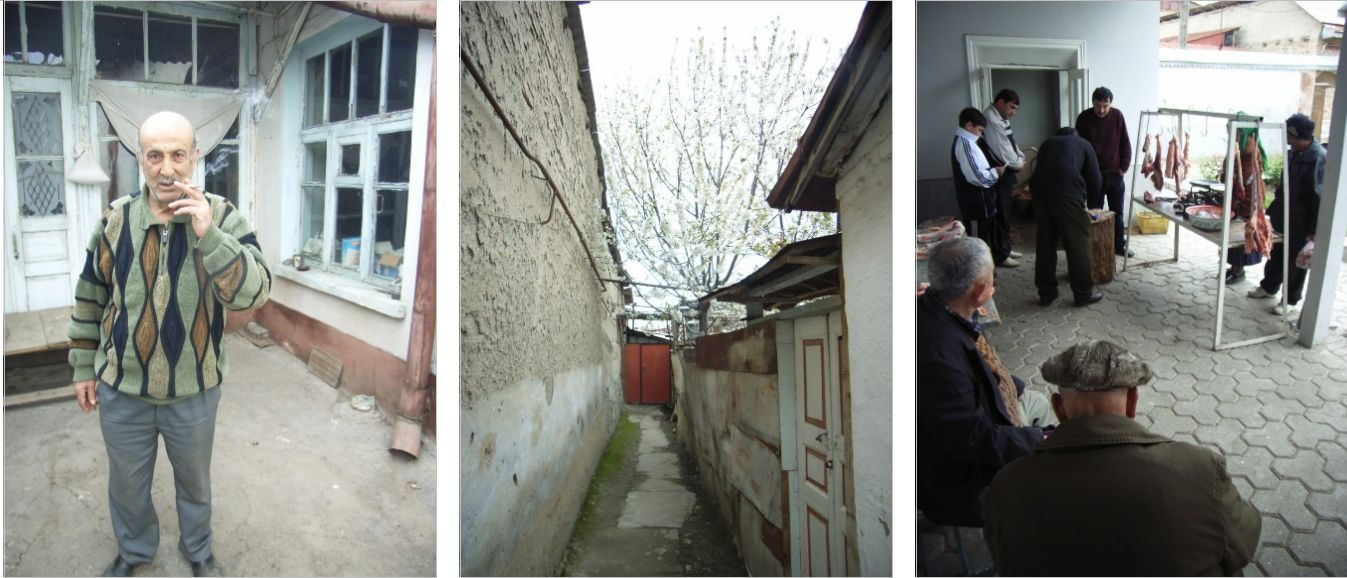
Arkadi smoking in his courtyard, entrance to his house, Arkadi (sitting with hat) in the Synagogue’s courtyard,
all pictures © by the author, Samarkand 2005
Arkadi did not speak much about himself. He was born in December 1939 and never left the Soviet Union. After returning from his three-year army service, he returned to his birth city, married, and worked as an inner-city bus driver in Samarkand. He retired from his job in 1995 and stayed in his family’s small courtyard in Uzbekistan after the collapse of the Soviet Union, and after his relatives, children, and his wife left for Israel and the United States. Arkadi (Abrash Abraham) Il’yasov passed away in Samarkand in 2020. He is buried at the town’s Jewish cemetery.
Here is a link to Arkadi’s birth certificate and a text I wrote about him for the online exhibition Soviet Central Asia in 100 Objects.
In 2016, I published his life story in my monograph, Bukharan Jews in the Soviet Union in a chapter titled “Close Relatives,” not knowing that this was not the last time I would have to deal with it. Now, 10 years later, I am still working on the history of the Jews in Central Asia and how these Jews were connected and interrelated before the Soviet Union closed its borders in the mid-1930s, and the Jews in Afghanistan started to leave the country for good. During a research trip to New York in November 2024, one of the stories Arkadi once told me in his kitchen in Samarkand came back to me in a very curious way.
It was the family lore of his grandmother Hano, who was born in Herat in 1876 and passed away in Samarkand in 1963. Here is Arkadi's version of it as I recorded, transcribed, and translated it that afternoon, sitting with him in his kitchen.
The Story of Bibi Hano and Rohel
When my forefathers moved to Afghanistan, my grandpa was born there, my father's father. In Persian [farsi], the word for ‘father’ is ‘ogho’. My father’s father was born there [in 1866], in the city of Herat. When he was a ten-year-old boy, one of his relatives gave birth to a child. While the wife was giving birth, the father of the newborn was sitting in his shop, selling things.
This boy [my grandpa] came and said, ‘Give me a gift21! I have good news for you!’ – ‘What’s up? What news?’ – ‘Your wife has had a child!’ – ‘Has she?!’ He hadn’t had any children so far. That was his firstborn. – ‘What is it?’ ‘I don’t know – a child.’ – ‘Daughter or son?’ ‘I don’t know!’ The man tells the ten-year-old boy, ‘Go and find out if it’s a girl or a boy, then come and tell me and I’ll give you a reward!’ Well, that boy hurried over there and found out what his relative had given birth to. (…) The boy went to his relative’s home and asked, ‘What’s Aunty Hano given birth to?’ – ‘A daughter!’ [they said]. And so he rushed back to the shop and said: ‘Uncle Levi, your wife has had a girl! Now give me a gift for the good news, please!’
But the man got angry. He’d hoped that the answer would be ‘a son’, so he didn’t give the boy anything. ‘I’ve come here for the second time now!’ [the boy said.] (…) ‘I’ve brought you the news. The first time I said that a baby had been born. You told me to go back and see if it was a girl or a boy. Now I’ve brought you the information that a girl’s been born. So give me the gift now!’ [The man] said, ‘Get lost! That girl is yours! The girl is your gift!’
The boy went away without saying another word. He left, very angry. The boy came of age, and so did that newborn girl. In those days, when a boy turned fifteen or sixteen, they would give him a female in marriage. Well, he came of age, and his parents said to him, ‘You’re grown up now, so we’ll find you a girl to marry.’ But he said, ‘I’m taking that Hano!’ Hano was the girl's name. ‘I’ll take Hano!’ he said. – ‘But Hano’s just a little girl. She’s not the right match for you! You’re ten years older than her. You’re fifteen already, and she’s only five or six!’ – ‘Then I’ll just wait!’ [he replied.]
He rejects all their suggestions. He said, ‘The father of that girl said that she’s mine! He didn’t give me anything; he just said, ‘The girl is yours.’
So I’m taking that girl!’
The boy waits until he’s 23. Then he tells his father, ‘Go and fetch me that girl Hano!’ Hano had grown up [by then]. She was already thirteen [in 1890]. At that time, they would marry off the girls at the age of twelve or thirteen. So there they went; they were relatives, so the father of the boy went to their relatives and said, ‘Levi, I’m taking that daughter of yours for my son!’ – [They talked about] this and that – finally, they say no. Then the boy – the groom – says, ‘Don’t you remember? You said this girl is yours! I’ve waited all this time. Now give me your daughter!’ So, they talked and talked and [Levi] agreed, and my grandpa married that girl. He married my grandma, and they lived right here in our house. Hano was the only child of her parents, but she gave birth to eighteen. She raised nine out of the eighteen. At that time, there was no medicine, and many children died. Now, please wait a moment… the tea will be ready in a minute […]
When Arkadi returned with a pot of green tea and some walnuts, he sat down and continued the story of his great-grandmother Hano and the family’s relocation:
Hano would have a baby every year. They already had three or four kids when they came to Marv in Turkmenistan in 1905. My grandpa was born in 1866, and my grandma in 1876. (…) They got married in 1890. At that time, my granny, Hano, was thirteen years old. They had several children in Afghanistan, in Herat. My grandpa started going to Marv to trade. He would bring stuff here to sell, then take other things from Marv to Iran and Afghanistan. (…) In Russian, his profession is called ‘kupets.’ In olden times, they would call [these people] ‘kupets’ [Russian for ‘merchant’]. At that time, the Muslims who lived in Afghanistan, Iran, and Central Asia couldn’t be traders. That’s why they would call Jews, and so they created the conditions for Jews to live and work in their cities, ‘We’ll give you permits, we’ll give you support!’
According to our [Jewish] law, no matter in which town Jews live, there have to be at least ten. Because for praying there have to be ten or more persons […] so my grandpa said, ‘I’m coming [to Marv] with my family and my relatives.’ They gave him a permit, and they moved to Marv. That was in 1905. There, my grandma had a few more children. My father was born in Marv in 1912. My grandpa moved again when he [my father] was still very young. [In the year of my father’s birth], they moved on from Marv to Kerki.
In November 2024, I was in New York to gather material and conduct interviews as part of my new research project on the Jewish triangle Afghanistan, Iran, and Central Asia. When I got talking to Abraham (Abe) Mor. Abe was born in 1938. When he was 12years old, he left Afghanistan with his family for Israel. He specialized as a polisher in the diamond industry. Later, he moved to New York and started his own business there. Abe Mor became a successful entrepreneur and a renowned diamond trader on Manhattan’s 47th Street. He is active and involved in the Jewish community in his New York neighborhood. Like most Afghan Jews in the United States, Abe carried his Afghan past and memories in his heart and only shared them within the confines of their small community. This changed after 9/11 when Afghanistan suddenly became of interest, and the United States of America started a war against the Taliban and promised to change the country. The Afghan community in New York was ready to help and, for the first time, felt proud of their past, going public with it.
Abe Mor has written several works on the history of the Jews of Herat and Kabul, and has recorded several CDs of Dari and Hebrew songs and prayers he remembered from his days in Herat and Kabul, as well as piyyutim of Bukharan Jews. At the end of one of our conversations, he asked me how I had come to be interested in the history of the Jews of Afghanistan. I told him about my first encounter with Arkadi Il’yasov in Samarkand, almost 20 years ago. He paused and asked again for the name: "Il’yasi, Il’yas," he murmured incredulously and told me that one of his aunts from Herat had been married to Kerki and that after a few years under Soviet rule, contact with her was lost. We were both excited about this possible connection and talked about it for a while. As we said goodbye, I promised Abe that I would email him my chapter about Arkadi and some photos I had taken with and of him in Samarkand as soon as I got home.
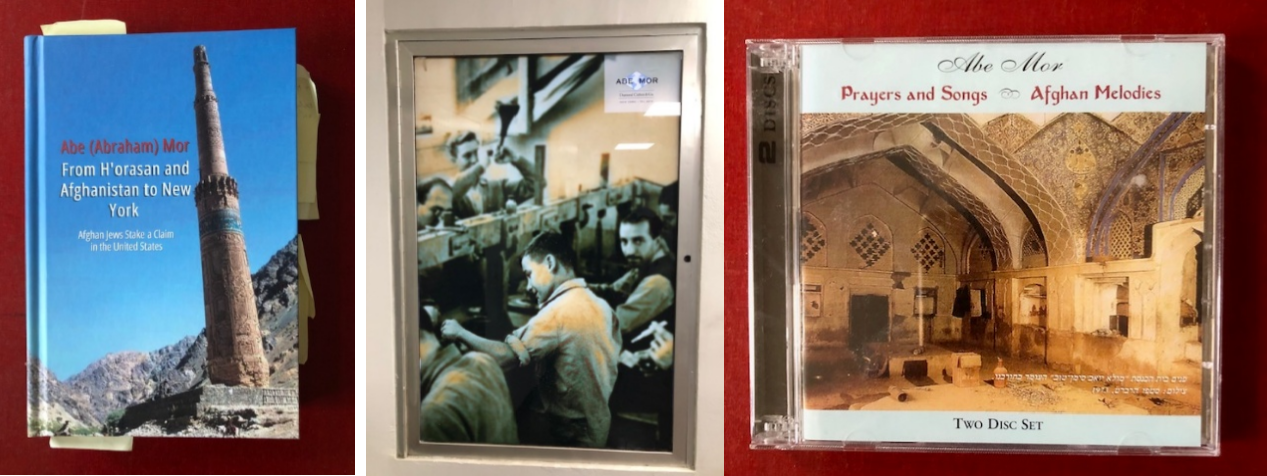
Cover of Abe More: “From Khorsasan and Afghanistan to New York” (English translation from the Hebrew Original, 2011); Abe as a young diamond polisher in Israel (sleeves rolled up), displayed in his Manhattan office; and his two-disc set “Prayers and Songs – Afghan Melodies” (2007)
Two days after I sent Abe everything I had, I received his WhatsApp message. “Thomas,” he wrote, “it's unbelievable, this Arkadi you told me about, he is my cousin!” Abe had sent the pictures and my text to a relative in Canada, who immediately confirmed that Arkadi belonged to the “lost part” of her family. For me, this encounter in New York had come full circle – after all, I owe the basic idea for my new research project to my encounter with Arkadi and his family history. But that wasn't the end of the story. Shortly afterwards, I received an email. It was from Roman Ilyasov in Los Angeles. He had heard from relatives that I was interested in the history of the Ilyasovs in Samarkand. Enclosed was a PDF of a book he had written about his family history and published himself. I opened the document and began reading. The second chapter was titled "Bibi Sevancha." A shiver ran down my spine. After reading the first few lines, I knew: this was exactly the story of the birth of his grandmother Hano, which Arkadi had told me in detail when we first met and which I had reproduced word for word in my chapter about him. In chapter four, it turned out that the author was the son of Arkadi’s father’s brother Yakov. I wrote him a long email and sent him a photo from Samarkand in 2005. It shows his cousin Arkadi in the cemetery of Samarkand, pointing to the grave of his uncle, who had died in 1991.
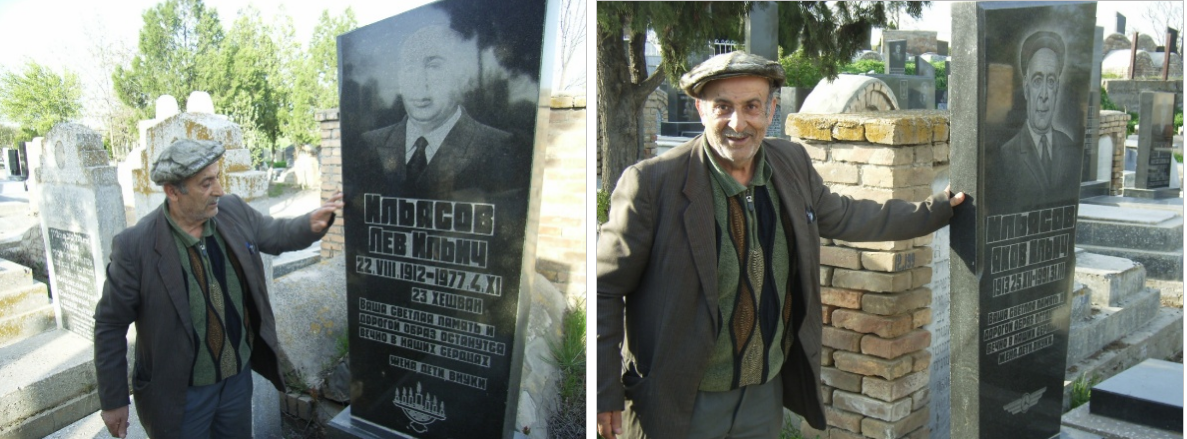
Arkadi showing me the grave of his father Levi (1912-1977) and his uncle Yakov (1913-1991),
all pictures © by the author, Samarkand 2005
Here follows an excerpt from Rahamim ben Yakov Bezalel (Roman) Ilyasov’s fascinating family chronicle Descendants of Bezalel (English translation of the Russian original, titled СОКРОВИЩНИЦА РОДА БЕЦАЛЕЛЬ, 2014), which brings together the Ilyasov, Bezalel, and Bassali families, the cities Mashhad, Herat, and Samarkand, as well as Afghanistan, Central Asia, Israel, and the United States.
Descendants of Bezalel, Chapter 2 “Grandmother Sevancha”:
…Today, as a descendant of the Bezalel, an ancient race of Afghan Jews, I would like to present one of our most entertaining stories. This happened about 136 years ago. Itis the story of my grandmother, Hana, who was also known as Grandma Sevancha, and my grandfather, Eliyahu. At this time, my grandfather was 10 years old. His father, Moshiach, of the Bezalel family, and his mother, Esther, a supercentenarian who was 122 when she died, lived in a house in the center of the Jewish quarter of Herat, Afghanistan, about 1.5 miles from the main shopping district and its large bazaar. In those days, the shopping district contained countless rows of stalls, mainly occupied by Jewish merchants. Goods came from many countries, and most of the people in charge of importing the goods were also Jews.
[…] Eliyahu’s father, Moshiah Bezalel, was born in 1808 in Mashhad, Iran. He was one of those elite merchants – a merchant of the first guild – who organized the import and export of goods through secure family connections between Iran, Afghanistan, Turkmenistan, and Uzbekistan.[…] Moshiah’s older sons also had shops in Herat’s bazaar. Their father bought almost all the foreign goods there. Eliyahu, who was 10, helped his father and his older brothers when he wasn’t studying.
Eliyahu was first in all things. Except for one: – sevancha, news about the birth of a child. Parents or relatives of the baby give a gift to the first person who brings the good news to the family. Persian, Afghan, and Bukharian Jews still adhere to this tradition. Almost all his friends at one point or another had the chance to participate in this pleasurable, fascinating, and unforgettable tradition. In all his 10 years, however, Eliyahu never had the chance to be the first to deliver someone the best message of all, and receive, as a token of gratitude, a gift of sevancha.
At night, Eliyahu’s friends would tell their fascinating stories about the first time they announced the arrival of a baby and the amazing gifts they received for performing such a wonderful task. He was green with envy. It was not in Eliyahu’s nature to sit patiently and wait for his dream to come true. He decided to facilitate the process. Like a man possessed, he went around the Jewish quarter, asking, not only friends, but everyone he met, whether they knew a woman who was to give birth soon. He finally got the information he was seeking. So, every morning before school and after going to the market, he would investigate. He would peer through the bars of the gate, hoping to see anything that might indicate the baby was coming.
Finally, the long-awaited day arrived. He saw two midwives rushing to the house of a wealthy merchant named Levy. The maid quickly swung open the heavy gate adorned with oriental carvings for the midwives. Before the gate completely closed, however, Eliyahu quickly asked the maid if Mister Levy was home. When he heard the merchant was still at the market, his heart skipped a beat. Here was his chance to bring the good news to the expectant father.
The fence was high, so Eliyahu had to climb the trunk of a mulberry tree to watch from the street. And while he sat on a branch, he saw what was happening in the yard and house. One midwife was bustling with white bed sheets on the veranda. The other shouted to a maid from a bedroom window to fetch some well water and warm it as soon as possible. The pregnant woman was a known beauty. Her name was Shoshanna. Eliyahu, still on the branch, crept closer to the fence. He held his breath and listened ecstatically to the loud cries coming from the bedroom. This meant a promised first sevancha for him. Suddenly, all noise had ceased, and, shortly after, he heard a newborn baby crying.
“What happiness! What happiness!” Eliyahu heard the maids exclaim.
“Shoshanna gave birth to a healthy, beautiful child!”
“Well, I waited, and, finally, my first sevancha!” Eliyahu thought happily and climbed fast down the tree. “I must run quickly to the market so someone does not beat me with this message.” He jumped down from the tree and ran as fast as he could to the market. Running 1.5 miles was a mere trifle for Eliyahu’s strong legs. And, he knew the market inside out. He soon found Levy’s shop, which was between the booths of Muso and Iso, his classmates’ parents.
“Sevancha! Sevancha!” Eliyahu shouted breathlessly, running up to Levy’s bench.
“Mister Levy, your wife just had a baby! Sevancha! Sevancha!”
“A child?!” Levy asked, somewhat surprised. “How can this be? This morning, there was no indication that my wife would deliver. Boy, are you sure? Are you sure that it was my wife who gave birth?”
“Yes!” Eliyahu said. “I know for sure because I just came from there. Your wife, Madame Shoshanna, just gave birth to a healthy, beautiful baby! There are two midwives in your yard now, along with many other women. Sevancha! Sevancha!”
“A healthy, beautiful baby!” said Levy, very emotional, almost crying with happiness. He shouted in the direction of the neighboring shops. “Muso-oh, Iso-oh! Have you heard the news?”
“Was it a boy or girl?” they asked Levy.
“Yes, really, was it a boy or a girl?” Levy asked Eliyahu.
Levy, Muso, and Iso all looked at Eliyahu at the same time, expecting an answer. Eliyahu froze, trying to recall what he had heard from the yard and whether he could identify the child’s gender.
“Hey, boy, are you deaf?” asked Levy. “Tell me what it is!”
“I do not know,” Eliyahu said apologetically. “As soon as I heard the baby was born healthy, I ran to tell you the good news immediately, and, in my haste, forgot to even find out if it was a boy or a girl.”
Muso and Iso grinned mischievously at this answer.
Levy said: “Well, then, if you want to get a good sevancha, go back and find out. Then come and tell me because, as you know, according to our tradition, good news should come with a comprehensive answer. For the nice message you just brought me, I will give you the most precious gift in the world. The sevancha will be such that you have never seen before or will ever see again.”
“Well, Mister Levy, I’ll bring you good news,” Eliyahu said enthusiastically and immediately began to run back to the house.
Meanwhile, a very happy Levy earnestly and carefully began sorting through jewelry on the shelves, placing pieces in a silver box. These were the gifts for Eliyahu.
Seeing what Levy was doing, Muso and Iso made fun of him.
Muso went first: “Levy? Hey Levy? Who are the gifts for, a boy or girl?”
“They are to celebrate my beautiful and healthy firstborn child,”
Levy said proudly. “I will name the baby Josef, in honor of my father.”
“Huh? Are you sure that it is a boy?” Iso asked with a sneer.
“Of course, I’m sure,” Levy protested. “My wife went to a fortune teller who said that our first baby will be a boy. Isn’t it obvious that the fortune teller was correct? During her pregnancy, Shoshanna’s belly was narrow, and she carried it high. That’s a sure sign that it would be a boy! Besides, my wife loves me so much that she dares not fail. She promised me that she would do everything she could to give me a beautiful and smart son who resembles me.”
“While we believe that your wife tried very hard, not everything depends on her,” Muso continued with his banter. “If it turns out to be a girl, it was your fault. You were the culprit.”
“Not the culprit, more like a bungler,” Iso said.
“What,” Levy asked indignantly.
“What do you mean the bungler? Yes, only you would think of something like this? As a rule, the firstborn in the Levy family has always been a boy. My parents’ first child was a boy. My brothers and my sister had boys first, and so did my aunts and uncles. And you think me a bungler? Are you not ashamed to think that? You can see how many expensive gifts I have prepared for the boy who will soon bring the good news!” With exaggerated pride, Levy took down a gold chain and a gold bracelet covered with stones and placed them in the silver box.
He said to Muso and Iso: “Look at the sevancha I prepared. Such a gift even the Shah of Persia would not bestow on someone. But, I do not mind. Let this boy remember his entire life from whom and for what he received such an extraordinary first sevancha. And he’ll tell all of Herat about it.”
Levy looked at the envious eyes of Muso and Iso, whose jaws were drooping and mouths were watering at the sight of the precious jewelry. He grinned smugly. He finally was able to render Muso and Iso speechless. Levy was constantly and impatiently looking between the market aisles for Eliyahu to return. After about an hour, he could see Eliyahu running towards him.
It was evident that the boy was very tired. This is understandable considering he just ran a total of 5 miles in one day. But, while Eliyahu was completely exhausted, Levy was beaming with happiness. “Look, look, Muso, Iso, look,” Levy shouted triumphantly, pointing to the running Eliyahu. “Look at this angelic boy. Do you see? His face says it all.” Sensing the pleasant news that was to come, Levy picked up the box to earnestly hand it over. He said to Muso and Iso, boasting: “Well, are you ready? Now, you can hear what the sex is.”
They all heard the announcement. “It’s a girl! It’s a girl!” Eliyahu shouted joyfully as he approached. “Mister Levy, you have a beautiful, healthy baby girl!”
Levy sat down on the spot. Muso and Iso were laughing loudly. “Mister Levy, you have a beautiful, healthy baby girl! Sevancha! Sevancha!”
Eliyahu mistook Muso and Iso’s laughter as a sign of joy and started to laugh with them. “It’s a girl! It’s a girl! Sevancha! Sevancha!” Eliyahu looked at the three men. Levy was jumping and stomping with frustration, but Muso and Iso were choking with laughter.
“You have got to be kidding me!”Levy suddenly cried out in anger. “Get out of here, you scoundrel! And get out of my sight!” He furiously threw the box into the far corner of his shop, grabbed a wooden stick lying behind the counter, and took a swing, trying to hit Eliyahu. Eliyahu had to jump back to a safe distance, and, not knowing what was happening, plaintively squeaked: “A sevancha? Mister Levy, you promised you would give me the most expensive gift in the world. Where is the sevancha that I had dreamed of all my life and honestly earned?” Eliyahu still did not believe what he had just witnessed and heard. Wiping the sweat from his face and tears from his eyes, he looked at the now quiet Muso and Iso and the savagely angry Levy. Confused, he stammered. “Mister Levy, you promised me sevancha for good and pleasant news. Answer me. Where is your merchant’s word?”
“I always kept my merchant’s word. And I always will!” Levy shouted, looking at the crowd that had gathered around the booths. “I promised a nice gift for the good news, but you just brought me bad news. You have disgraced me in front of the entire market. Because of you, everyone will be laughing at me behind my back. “A girl! A girl!” Levy continued in disgust, mimicking Eliyahu’s words. “Get out of here, you scoundrel! You’ll remember this little girl for as long as you live – this girl for whom you would like to receive sevancha from me. Get out! And let her be your sevancha!”
After hearing these words, Eliyahu’s tears immediately dried up. He shook with anger and said: “OK, Mister Levy, I shall leave. But, remember what I say to you now. You said this girl is my sevancha! There will come a time when you will be held accountable for what you have just said and done to me. My name is Eliyahu! Remember that. And remember also that it was your merchant’s word that you will honor in the future.”
And we do know how the story continues. Fourteen years later, the now grown-up boy returned to the merchant and asked for his promised gift – the sevancha. The Jewish merchant kept word, and Eliyahu married the girl. Later, the couple left Herat for Russian Turkestan. Times changed, and so did the political systems and borders in Central Asia. Families were ripped apart. Some Jews emigrated, and some Jews had to stay in the Soviet Union. And the Hana became the grandmother of Abrasha, aka Arkadi, whom I first met in 2005.
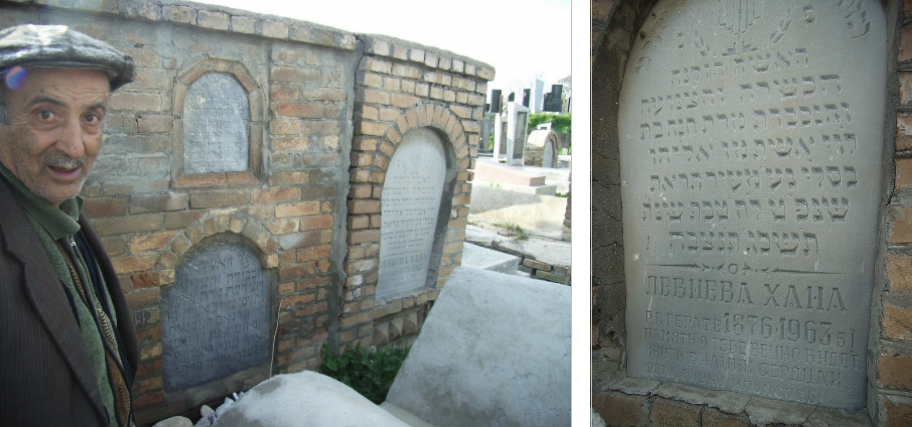
Arkadi in front of family graves, gravestone of Hana Levieva (Herat 1876 - Samarkand 1963).
Photo © by the author, Samarkand 2005
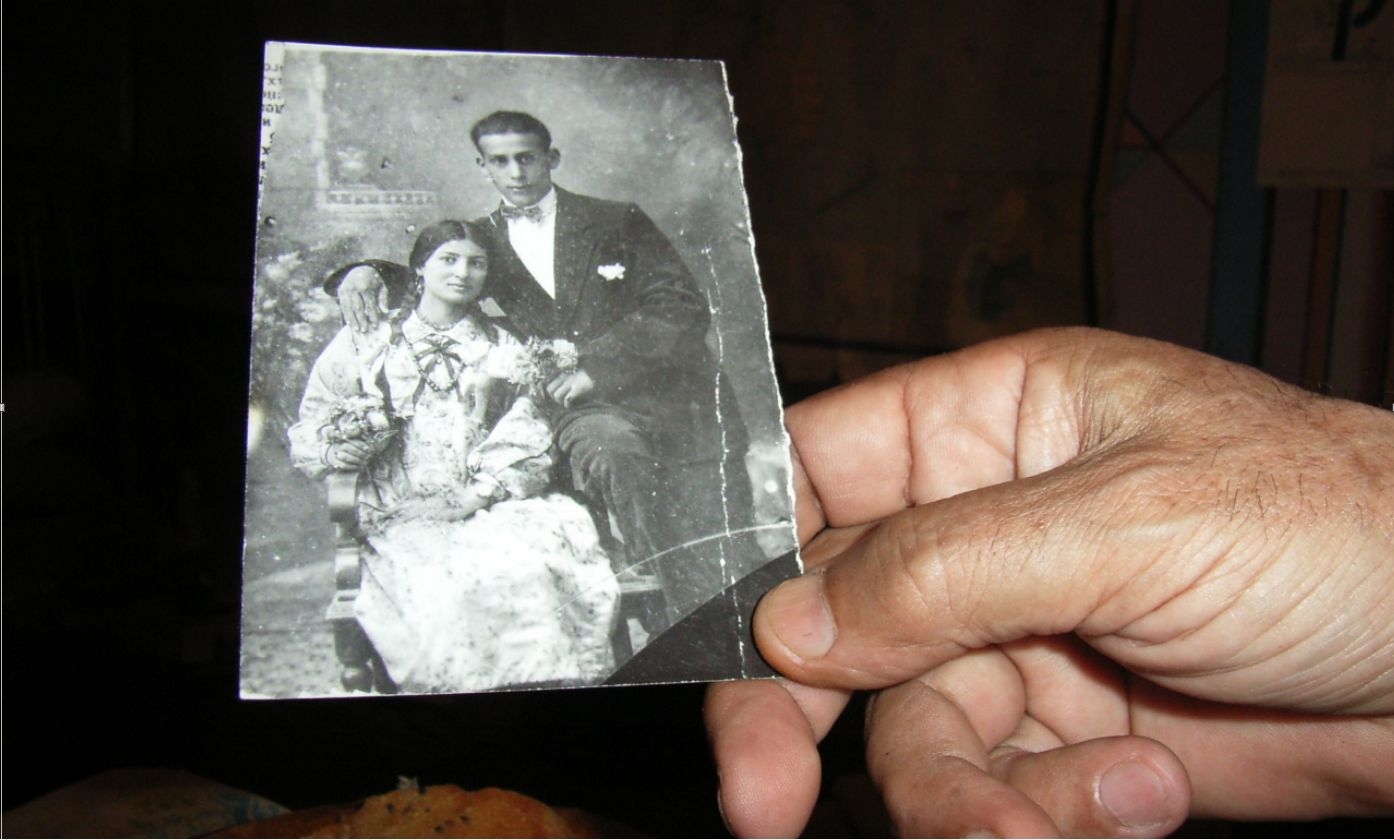
During one of our meetings in 2005, Arkadi showed me some family photos. On one, we see his father (Levi) and his mother (Rohel/Rachel) shortly after their 1930 marriage, posing at a photo studio on their honeymoon. In this picture, Levi wears a fine suit, a white shirt, and a bow. His wife Rachel sits with a dress she sewed herself. According to Arkadi’s sister, Reyna, it was Abe Mor’s aunt (also named Rohel/Rachel), who taught her embroidery. Abe Mor’s aunt, who was married in Marv or Kerki to Issachar and who belonged to the part of the Mor (Mordekhay) family that was cut off when the Soviet-Afghan border was closed in the Mid-1930s. She was married to Arkadi’s and Roman’s uncle Issachar.
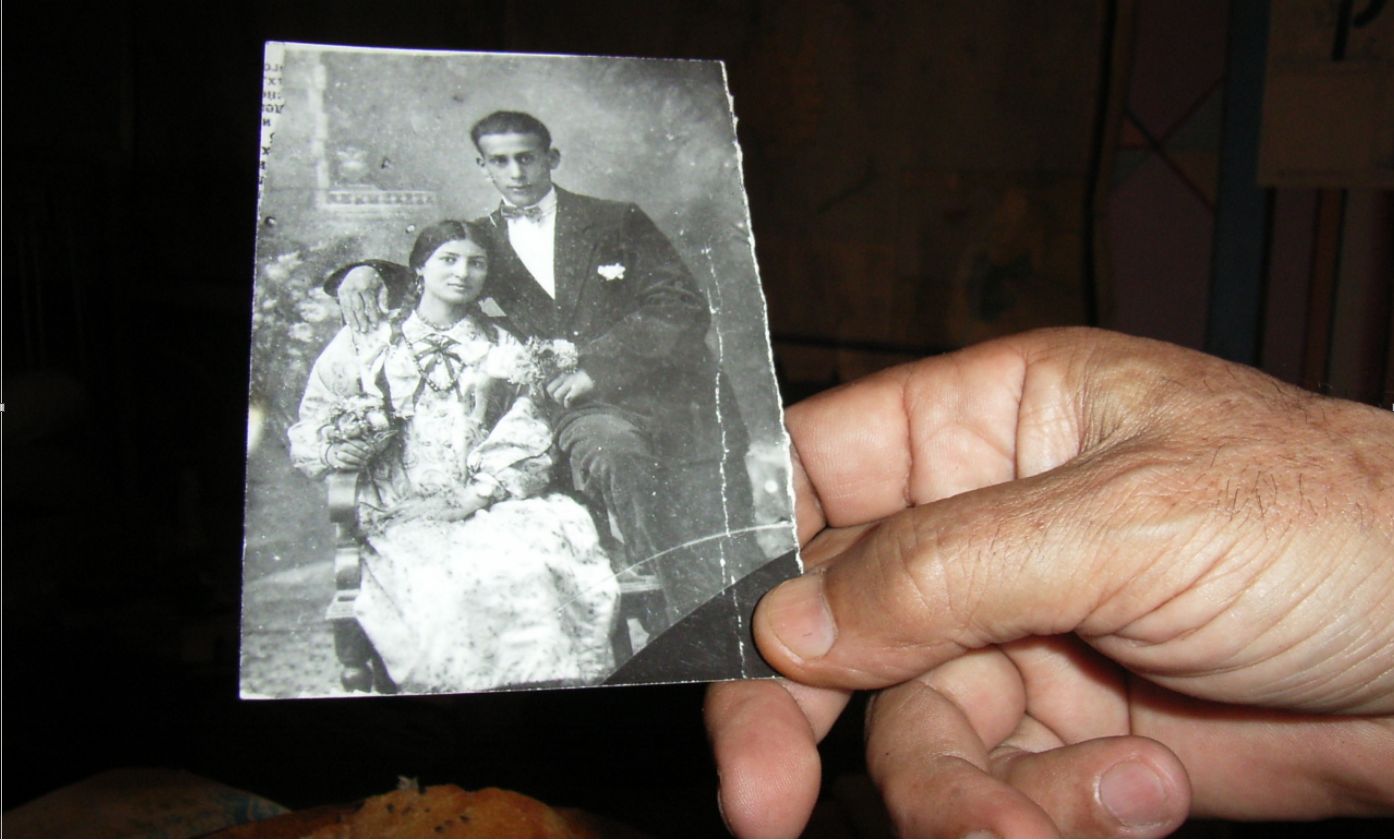
Rohel (1913 Kerki – 2006 Israel), granddaughter of Hano (Bibi Sevancha).
Levi (1912 Kerki – 1977 Samarkand), son of Hano (Bibi Sevancha).
Arkadi (1939 Samarkand – 2018 Samarkand), Rohel and Levi’s fourth child out of six.
I am grateful to Rahamim ben Yakov Bezalel (Roman) Ilyasov and Abe (Abraham) Mor for sharing their family stories and their consent to publish these materials/photos here. I am also grateful to Rena Ilyasova (Arkadi’s sister in Israel), who was called by Roman Ilyasov, when I asked him about the photo of the newlyweds Arkadi showed me. She told him about the dress and how it relates to Abe and Herati with the Bukharan Jews.