
In 1910, a correspondent of the Chicago Record-Herald travelled through Russian Turkestan along the Trans-Caspian railway with major stops in Ashkhabad, Merv, Bukhara, Samarkand, Tashkent, and Kokand. After writing and sending back some “newspaper letters” about his journey, William Eleroy Curtis published his observations in the book Turkestan: The Heart of Asia (New York, 1911).
Cover of Curtis’ book (New York, 1911)
Curtis viewed the region through an “imperial lens”, praising the Russian “civilizing mission.” He was impressed by the Central Asia Railway, which he saw as a vital tool for military control and economic modernization. He was particularly interested in the economic development and potential of Turkestan. He also described the people he met on his trip, among them the Jews who lived and traded in the towns he visited.
In Curtis' book, we first encounter Jews on page 49 during his brief visit to Ashgabat. After mentioning “a Lutheran church of neat design near the railway station”, he wondered that there was “no sign of a mosque or a synagogue, although the activity of the business quarter has attracted a large number of Persians and Jews.” As in Merv and, probably, all the other stations between the Caspian Sea and the Chinese boundary in the Ferghana region, economic opportunities attracted Jews from all over the “Jewish Triangle” to the newly emerging trade hubs that quickly became towns. There was lively traffic on the trains and from the stations in Transcaspia to Persia and Afghanistan.
A regular line of diligences runs in connection with the railway trains from Askabad to Meshed, making the journey in five days, and they are patronized by thousands of pilgrims who come from western Persia and from the cities on the Caspian every year” (p. 51).
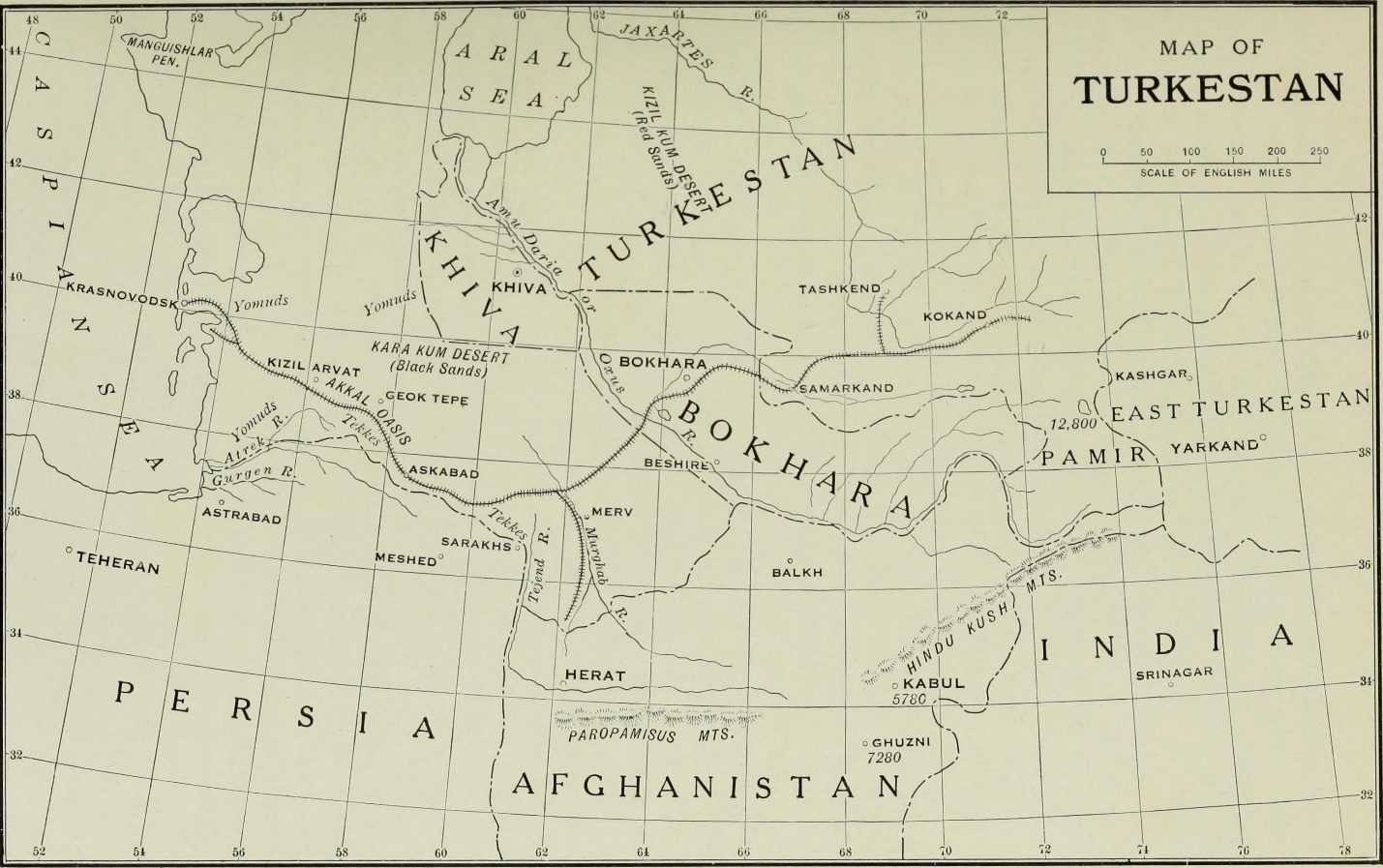
Map of Turkestan (with Trans-Caspian railway from Krasnovodsk to Kokand and Andijan)
Hawley, W. A. (Walter Augustus), 1863-1920, via Wikimedia Commons (published 1922)
Muslim and Jewish traders used camel caravans on the same routes to transport their goods before or after loading them onto the railway. Jews from Mashhad, Herat, and Bukhara were among these traders and families who settled in the emerging towns along the railway. But probably Curtis did not stay long enough to describe them or their contribution to the economic development and growth of Transcaspia. As many of these Jews had come to these territories only after the Russian conquest, they were not considered subjects of the Tsar, but foreigners, with special rights and restrictions. In 1911, the Russians prohibited foreign Jews (including Afghan, Persian, and Bukharan subjects) from residing in the border areas of Russian Turkestan. Only the Mashhadi Jews, who the Russian authorities regarded as Muslims (due to their history as ǰadīd al-islām), were allowed to stay. In a recently published memoir of a Herati Jew the implementation and consequences of this law were describes as follows (Abraham-Klein: The Stateless Central Asian Merchant, 2025: p. 39):
The Afghan and Bukharan immigrants were to leave the (sic!) Russian Turkestan. Those who could not prove to have lived in the region before the Russian annexation had to leave the border area and move to other cities in Russian Turkestan, such as Samarkand, Tashkent, or the Fergana region in Uzbekistan. The order was approved, and the deportation took about two years. The Afghan Jews, for the most part, returned to Herat in Afghanistan; the Bukharans to Samarkand; and our family traveled to Samarkand (since we had relatives there).
According to a report in the Bukharan Jewish newspaper Rakhamim, which was published in Skobeleff from 1910 to 1916, in early June 1911, the Russian authorities evicted many Herati and Mashhadi Jews from the Transcaspian border region: 80 families from Marv, 40 families from Bairam-Ali, and 125 families from Takhta-Bazar. (See my article)
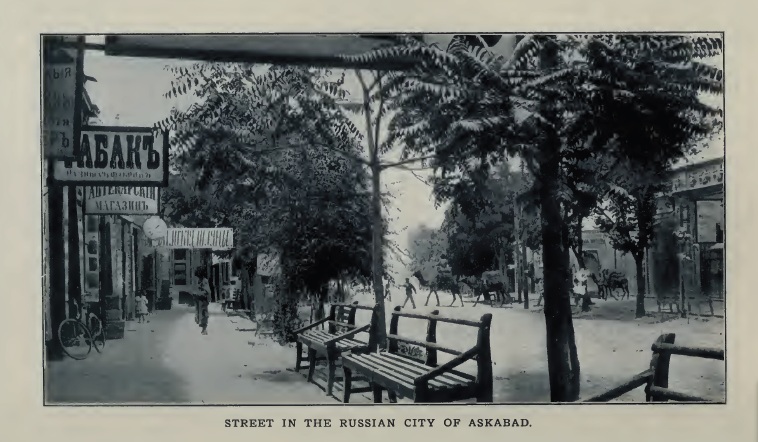
© William E. Curtis, Turkestan, p. 49
Curtis’ next bigger stop was Bukhara. Here, at Kagan station, he saw a crowd of 300–400 people of all ages “representing a dozen different races”, and nearly all of whom were dressed in exotic clothing. (p.99). Next to Turkmen and Persians,
there were many Jews, who can also be identified by the distinctive features of their race. The old men wore patriarchal beards under their snowy white turbans. They looked like men of intellect and learning, and of all the people in the East none carry themselves with a more dignified and serene air. The young Jews are alert and active, and the children have most interesting faces.
Curtis was also enthusiastic about the appearance of the other groups in the city: “The Usbegs, as the inhabitants of the khanate of Bokhara are called, are quite as dignified and stately in their movements as the Jews and wear the same serene expression upon their faces. They are unusually handsome men” (p. 101). While Curtis had encountered many European faces on his journey up to that point, they were almost absent in Bukhara. Of the “325,000” inhabitants of the emirate (Curtis p. 101 incorrectly writes “in the city”), there were, as Curtis tells his American readers, “perhaps [only] 250 Europeans, chiefly Russians, Germans, or Poles” (ibid.). Curtis did not describe much of Jewish life in the city, but he concluded that, “[although] Bokhara is, perhaps, the most intolerant community outside of Thibet. The Jews have always been kindly treated, and Hindu Brahmins are now safe.”
Right at the train station, probably as he continued his journey towards Samarkand, Curtis describes a farewell scene involving a group of Jews (pp.100-101):
A Jewish patriarch, with a long, snowy beard, a noble forehead, a prominent nose, and large, thoughtful, brown eyes, was leaving. He might have been a rabbi, and a large number of his friends, perhaps forty or fifty, had come to the station to see him off. On the Central Asia Railway the conductor gives the passenger plenty of notice beforethe cars start. A bell attached to a bracket over the door of the station rings three times: first, to give general warning; after five or six minutes, again, to get on board; and then, after two or three minutes more, a single stroke is followed by the whistle of the locomotive and the start. After the first bell the Jews gathered in a circle apart from the rest of the crowd, with half a dozen little children in the centre, and the patriarch, who was going away, folded his hands upon his heart and. offered a prayer, while the rest reverently bowed their heads. Then one after another, young and old, passed before him and he kissed them on both cheeks. The children came last, and he blessed them, with his fingers resting upon their heads; then lifted each one in his arms and kissed him affectionately. Every one in the party was weeping; one of the children became hysterical and would not be comforted. He was carried away crying just as the third bell struck, when the patriarch mounted the platform of his car and extended his hands as if pronouncing a benediction.
When Curtis traveled through Central Asia, Russian Turkestan was at its economic peak, and numerous modern banks were operating. At the same time, traditional private moneylenders still existed. On page 155, he writes:
The chief money lenders and bankers of Turkestan are Jews. There are a few Armenians in the business also, but they are exceedingly unpopular because of a general impression that all Armenians are English spies. This is based upon the fact that Great Britain has endeavoured to protect the Armenian people from the persecution of the Turks. There are some Afghan and Hindu bankers also, and occasionally a native Bokharoit goes into that business. There are more natives engaged in banking and money lending in the Russian provinces of Khiva, Merv, Samarkand, Kokand, and Tashkend than in Bokhara, however. The more a community becomes civilized the less scrupulous are the Moslems in the observance of the teachings of the Koran.
After leaving Bukhara, Curtis' next stop was in Samarkand. He was again in a Russian-ruled and administered territory. On page 236, Curtis describes Hindu merchants and also mentions Jews, who operated as long-distance traders and moneylenders all over Central Asia:
We saw our first Hindus in Samarkand, but many of them are there. They control the tea trade and are money changers and general brokers. The Koran, as you know, prohibits the followers of the Prophet from loaning money at interest and imposes awful penalties upon usury. Hence no orthodox Mohammedan can engage in the banking business or place his funds where they can draw interest. Hence he dodges these rules by entering into partnership with Hindus and sometimes with Jews, whose religion does not expressly forbid them to "skin" a debtor when they get a chance. Several of the Hindus are engaged in the caravan trade and send wheat, wool, and manufactured merchandise across the mountains into Afghanistan, India, and China.
Curtis did not tell his readers that many of these Hindu and Sikh merchants – also known as Shikapuris and Multanis – had left Russian Turkestan by the 1880s and 1890s. They were effectively marginalized by the Russian administration, which made their continued presence increasingly difficult through legal and commercial pressures. Scott Levi, who has written a groundbreaking study of the Hindu and Sikh merchant networks in Central Asia concludes his entry on these groups in the Encyclopaedia Iranica by writing that "The strength and numbers of the Indian diaspora in Central Asia declined rapidly following the Russian conquest of Tashkent in 1865 […] as Russian control expanded to cover virtually all of Central Asia, the Indians abandoned their communities there and, by the time of the 1917 Bolshevik Revolution, the Indian diaspora in Central Asia had declined to such a degree that it almost no longer existed.”
We saw our first Hindus in Samarkand, but many of them are there. They control the tea trade and are money changers and general brokers. The Koran, as you know, prohibits the followers of the Prophet from loaning money at interest and imposes awful penalties upon usury. Hence no orthodox Mohammedan can engage in the banking business or place his funds where they can draw interest. Hence he dodges these rules by entering into partnership with Hindus and sometimes with Jews, whose religion does not expressly forbid them to "skin" a debtor when they get a chance. Several of the Hindus are engaged in the caravan trade and send wheat, wool, and manufactured merchandise across the mountains into Afghanistan, India, and China.
According to Curtis, “until American cotton was introduced by General Kaufmann, viceroy of Turkestan in the [18]80’s, silk culture was the most important industry in Turkestan” (pp. 170-171). Unfortunately, he did not have enough time to observe the individual steps involved in silk production and processing. He did not describe the steps in detail, but summarized this topic as follows:
The best silk in Central Asia is produced in Bokhara; next comes that of Kokand and then that of Khiva. Silk is spun and woven in the households by women and children and the yarn is dyed by the Jews. The colours are absolutely durable and the fabric has a firmness and brightness which are never lost. The lustre for which the Bokhara silks are famous is produced by beating the yarn with a wide, flat, wooden flail.
Since many Jews in Bukhara worked as dyers, there is still a widespread claim that Bukharan Jews could be recognized by their indigo-dyed hands. The Russians had started importing European machinery and, apparently, “millions of eggs from France” to modernize the silk business. According to a report in the Bukharan Jewish newspaper Rakhamim, silk eggs were also imported to Central Asia from the Ottoman Empire.
The longest continuous passage on Jews is under the heading “The Bazaars of Bokhara” on pages 174-176. Here, Curtis describes their position and activities within the Emirate of Bukhara and Russian Turkestan and shortly introduces his understanding of their origins to his American readers. At its end, he also mentions the myth that the Pashtuns (Afghans) – or better, a large part of them – have Jewish roots.
The Jews are a very large and important element in the population of Bokhara, and their business ability, their honourable dealings, and their enterprise have won for them unlimited credit, commercial and moral. They are the leading merchants and bankers of the place; they control the silk market; they own most of the camel caravans which furnish transportation to China, Afghanistan, and various sections of Turkestan; they are largely interested in the rug business and in handling Persian lamb-skins, and are so skilful in dyeing wools and silk that they practically monopolize that business. If you will watch them closely you will notice that the fingers of half the Jews you see in bazaars and on the streets, at the railway stations and elsewhere, are stained up to the knuckles with the dyes they use.
The Jews of Bokhara and Samarkand and other cities of Turkestan are nearly all descended from Israelites who drifted over from Assyria at the time of the captivity, and have lived unmolested ever since, although they have been restricted at times and have often been compelled to pay blackmail for protection; but that has been the experience of every rich man. Whenever one of the despotic chiefs who have ruled that country, or any other semi-civilized country, for that matter, feels the need of money he gets it the easiest way he can. That is usually by squeezing it out of those of his subjects who have it to spare, and the Jews have been the easiest marks. Their wealth, however, is overestimated from our point of view. People there have a lower standard. A man who is worth 100,000 rubles is considered rich, while one who has 1,000,000 rubles, which is equivalent to $500,000, is a Croesus. Before the Russians came, and even now, in Bokhara, those who saved money were compelled to hide it and pretend that they were poor. No man will admit that he has money in Bokhara even to-day, because the tax collectors are compelled to satisfy the demands of the emir, who is a perfect cormorant, and assesses without mercy those who are able to pay. That is the reason the Jewish population of Bokhara is falling off and that of Samarkand, Tashkend, Kokand, and other Russian cities is increasing so rapidly. The Russians are fair to the Jews in all these Asiatic settlements because they need their money and their enterprise, but there is no telling what will happen when they begin to crowd their Russian competitors off the road. The persecution of the Jews in Russia has never been due to religious prejudice, but to professional and commercial jealousy. The Jews are so much superior to the Russians in ability, industry, enterprise, and in the other qualities which are necessary for success in every-day business and in every community, that they are absorbing about all that is worth having, and the only way the Russians can hold their own is by depriving their Jewish competitors of the means and opportunities of making money.
There are Jewish quarters in all of the cities of Turkestan and the limits of some of them were fixed by authority, and the Jews were confined to them at one time, but to-day a Jew can live where he likes and carry on any business that suits him. There are no restrictions whatever. Formerly under the khans they were forbidden horses and could ride only donkeys. They were compelled to wear ropes for girdles; many of them do so still, for they consider them badges of honour, but the young men dress like the rest of the community. Jewish women, as a protection against insult and unpleasant remarks, wear the same veils that are used by the Moslem women. They would be too conspicuous if they went into the street without them, but they discard them at home, and men and women mingle together as freely as in the United States.
There are a number of synagogues in Bokhara and Samarkand, but they are not conspicuous. The policy of the race has been to avoid attracting more attention than is necessary. The merchants observe Saturday and attend religious services in the morning. Some of them open their shops Saturday afternoon. They keep open on Friday, which is the Mohammedan Sabbath, and on Sunday. All the shops are open on Sunday, even those of the Greeks, but on Friday business is partially suspended. The Afghans also claim to be descendants of the Jews of the captivity and there are traditions that large numbers of families migrated from Babylon to Afghanistan.
In Samarkand, Curtis also describes the mosques and shrines. Interestingly, one of them, the tomb of Daniel, was (and still is) important for Muslims and Jews. The Jewish cemetery, located close to the famous medieval Muslim necropolis of Shahi Zinda, is not mentioned by Curtis. But Daniel’s tomb and the story connected to it received much of his attention (pp. 272 - 274):
Daniel's tomb is in the walls of the citadel at Susa. He was buried with the kings, proving the honour in which he was held and the eminence which he attained. His tomb is well preserved, is shaded by groves of palms and reverently guarded by a group of rabbis. It is venerated by Moslems as well as by Jews and visited by hundreds of thousands of pilgrims whose contributions pay for its maintenance.
There are khans erected expressly to accommodate them.
The theory of the Samarkand Moslems and Jews is that Tamerlane, after he conquered Persia, brought the remains of Daniel to Samarkand and left the tomb at Susa empty; but archaeologists believe that a misapprehension has been caused by a similarity in the name of the great Usbeg statesman, Daniel Bi, who was a khan of Samarkand for more than thirty years in the earlier part of the seventeenth century, and was buried in the tomb which is worshipped for that of Daniel the Prophet. It is not nearly so fine or imposing as the original tomb of Daniel at Susa, although it is well kept.
It is well situated about two miles from the city and is reached by a rough and much-travelled road, always deep in mud or deep in dust, according to the season, which leads through a desolate and neglected cemetery and lifeless sand hills. While we were driving out that way we met several parties of pilgrims who had come all the way from Persia to venerate the Jewish prophet, and they believe that the remains were transferred from Susa here by Tamerlane in the latter part of the fourteenth century.
The mausoleum is an unpretentious building of mud brick, coated with plaster and roofed with tiles. There is a mosque beside it and a large cave in the rock in which pilgrims are accustomed to find accommodations when they have no means to pay hotel bills. From the entrance to the tomb you look down upon a romantic little gorge through which the River Siop flows and turns the wheel of a flour mill, almost at Daniel's feet. The surroundings are very attractive, the trees are thick and in good condition, and everything looks prosperous and well cared for. The sarcophagus of Daniel is about sixty feet long, six feet wide and five feet high, and the attendant told us that the prophet filled every inch of it. They were big men in those days, he said; the human stature had been growing less and less annually for hundreds of years. Tamerlane was also a very large man, twenty-five or thirty feet tall, and while he could not give us the exact dimensions of Daniel the Prophet, he was so tall that he could step over an ordinary cabin. Noah, who is buried near Damascus, according to tradition, was sixty-five feet high, and other of the patriarchs were of similar stature. I have never been able to get from any of these people an explanation of their theory for the diminishing stature of the human race, but I suppose they have some good reason for it.
The tombs of Noah and other patriarchs and prophets that I have seen and the tombs of Esther and Mordecai are blanketed with costly Persian shawls, and that is the custom in India and Turkey. But Daniel’s sarcophagus is as bare as the hillside upon which it stands, except for some little red flags and horses’ tails and innumerable pebbles placed upon it by pilgrims, each pebble representing a prayer. The Mohammedans place pebbles upon the tombs of the dead whom they revere and upon the altars in their mosques, just as the Roman Catholics burn candles before their altars.
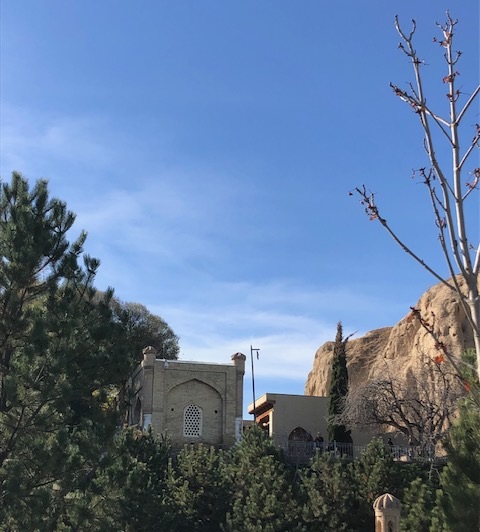
Daniel’s Tomb in Samarkand © Thomas Loy (Nov 2023)
In this context (pp. 271-272), Curtis also mentions that “Esther and Mordecai, her uncle, who was also prime minister, are buried at Hamadan, Persia, and their tombs are kept in perfect order by Jewish custodians and are the object of pilgrimages from all the Jewish communities in the east.”
His visit and lively description of Tashkent has no mention of Jews.
Finally, Curtis reached the Ferghana valley, “the most fertile section of Turkestan”. He saw the engineering of the irrigation systems in the valley at the same level, or even more advanced, as the comparable “miracle” of California and Utah (p. 313). Kokand, the capital of the formerly independent Khanate, was at the time one of the largest, wealthiest, and most developed cities of Russian Turkestan. Curtis described it as “a thriving city of 75,000 or 85,000 population” divided into an old “Muslim” and a new “Russian” town with a population of about 10,000 “who live on both sides of two long, wide, well-shaded streets named in honour of Skobeleff and Rosenbach, the Russian generals, who massacred more natives in the subjugation of Turkestan than any others” (pp. 314-315). And he continues, “as in other Russian settlements of Turkestan, everybody has a garden and a grove, and surrounds them with high mud walls so that you can see only the tops of the trees.”
Curtis was impressed by “modern Kokand … because it represents life and progress. There is something doing every day in the development of natural resources and in extending the wealth-producing capacity of the country” (p. 314). He also writes (pp. 315-316):
The Russo-Chinese bank and other financial institutions have branches there, and do a large business for the size of the town. I do not know another community of similar population that has an export trade of larger proportions and profits — chiefly cotton, wool, hides, Persian lambskins, and rugs — and the volume of imports seems unnecessary until you come to understand the vast quantities of merchandise of every sort that are shipped through the mountains by camel caravans into China. This business is altogether in the hands of Jews, who have the reputation of being very rich, but $100,000 is considered a large fortune here. The natives own the camels and handle the caravans, the camel drivers being Turkomans or Persians, and the Jews furnish the freight.
The population of certain sections of China, on the eastern side of the mountains, is quite dense, and until the Central Asia Railway was built their limited supply of foreign merchandise came up the Yangtse River from Shanghai, being handled largely by English firms, but the Russians are gradually wresting the trade away.
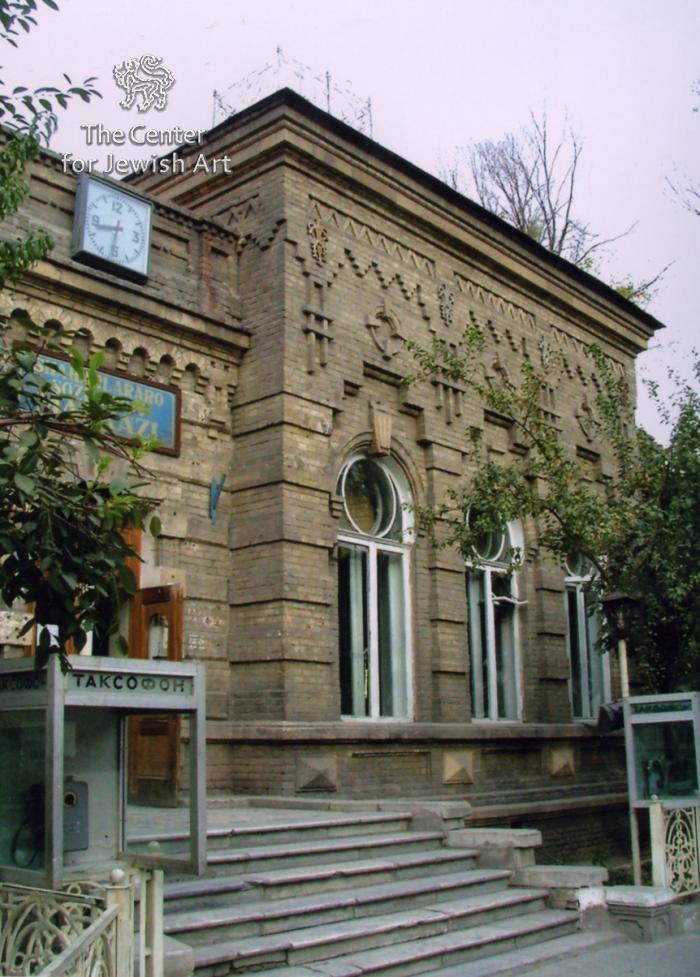
Rafael Poteliakhov’s mansion in Kokand (built 1907) is today a Post Office.
© Center for Jewish Art, Photographer: Zoya Arshavski, 2004.
The Center for Jewish Art contains many more historical and contemporary photos of Bukharan Jewish architectural sites in towns visited by William Eleroy Curtis (click here for Kokand).
The local Jews were heavily involved in the region’s economy. Although Curtis does not mention the names of the most wealthy Jewish entrepreneur families in Kokand and other towns in the Ferghana valley and Russian Turkestan, who had turned their “patriarchal family businesses … into modern trading and industrial companies” (Vladimir N. Shaydurov), such as the Davydovs, Poteliakhovs, Simkhaevs, Vadiaevs… In 2015, Imanuel Rybakov has compiled and published material on the most famous Bukharan Jewish merchant families in Turkestan – an English version titled “The Bukharan Jewish Merchant Class” was released in 2017. Curtis concludes the previously cited paragraph with the observation that “the Jewish merchants are very enterprising” (p. 316) – as we have seen through his eyes and through the train window, not only in the Ferghana region but all over Russian Turkestan.
Finally, Curtis also visited Margilan and Andijan, “at the foot of the Altai Mountains on the borders of the Chinese province of Tia-Shan-Nan-Lu” and “the terminus of the Central Asian railway” (p. 322) When he stepped out of his train carriage, he was more than impressed: “Andijan is the wealthiest and most important city east of Tashkend […] the railway reached there in 1899, and for several years thereafter Andijan experienced something like an American or Canadian boom” (ibid.).
Local Jews played a key role in this period of economic growth. The height of which has been witnessed and documented by William Eleroy Curtis. A few years later, World War I broke out and rang the bell for the last round of the Russian Empire. In 1916, Russian Turkestan sank into turmoil (see here). The Bolshevik revolution further contributed to the economic decline and finally the end of Jewish entrepreneurial efforts and successes in Central Asia (see here).
By Thomas Loy