


In late November 1933, at the start of his journey from Herat to Balkh, the British travel writer, art critic, and historian Robert Byron on The Road to Oxiana encountered groups of Jews who were traveling in the opposite direction – not as travelers, but as refugees crammed onto trucks. Near Qalʿa-ye Nau, Byron saw four such trucks coming from Andkhoi via Maimana and spoke with some of the passengers. These Jews, who hailed from the Soviet territories north of the Amu Darya, were fleeing the constraints of Stalin’s economic policies and intensifying political repressions.

By Central Intelligence Agency (CIA) 1983 (detail, marked by the author). Perry-Castañeda Library Map Collection, 2017, Public Domain. https://commons.wikimedia.org/w/index.php?curid=64651246
The abolition of the New Economic Policy, the forced collectivization, and the introduction of the command economy at the beginning of the 1930s immediately worsened living conditions and prospects, not only for the Jewish population, but for all Soviet citizens. Merchants and small business owners, who had enabled the Soviet economy to survive in the 1920s, were now criminalized, persecuted as anti-Soviet enemies, with their property confiscated. The harsh and inhumane policies caused a wave of mass emigration from Soviet Central Asia to Afghanistan. Between 1929 and the mid-1930s, when the border to Afghanistan and Iran became virtually impassable (and remained so for the next 50 years), approximately 4,000 Bukharan Jews (about one tenth of the total population) escaped from the Soviet Union via this route.
Due to heavy rain and snowfall and the resulting disastrous road conditions, the four trucks carrying more than 60 Jewish refugees were forced to interrupt their journey and head back to Qal'a-ye Nau. On their way to Herat they had gotten stuck in the mud. One day later, on December 1, 1933, a group of Turkmen also found themselves stranded in the small town of 2,000 inhabitants, about 160 km northeast of Herat:
Owing to this influx, food is short. There is no fuel. And as I can only light the room by opening the doors, I have to keep warm by putting on all my clothes and staying in bed. The shops sell Russian cigarettes and Swan ink, neither of which is much comfort. But I have bought some home-knitted socks that would resist the North Pole [...] Meanwhile the snow continues, and they have sent to Herat for horses, to fetch the Jews. Perhaps I ought to go back with them. (Byron, p. 141)
Most of the Jews Byron encountered attempted to make their way overland to Erets Israel/Palestine. The Afghan government did not welcome the Jewish refugees from Soviet Central Asia. On the contrary, they responded by expelling all Jews from northern Afghanistan. In doing so, they also severely restricted the economic conditions for Afghan Jews. Many refugees succeeded in their long and complicated journey, which took them from Herat to Mashhad, Tehran, and from there to Damascus and, with or without entry visas, into the British Mandate territory under the administration of the League of Nations. Others attempted to reach Palestine via Kandahar and British India, and from there by ship to Basra and Baghdad. Still others stayed in Afghanistan or got stuck along the way. Some of their stories I encountered recently in the Wiener Holocaust Library in London (FO 371/42862).
In July 1944, in a telegram from Teheran, Sir Reader Bullard, a British representative in Iran, informed the Government of India about a large group of Bukharan Jewish refugees, waiting in Persia for transmission to Palestine, about ten years after they had escaped from Soviet Central Asia.
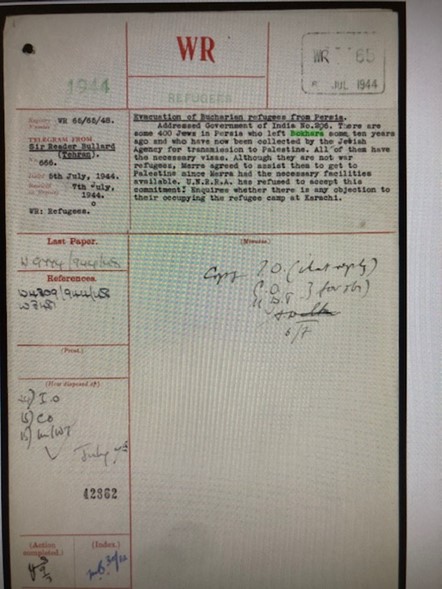
The telegram reads as follows:
There are some 400 Jews in Persia who have left Bokhara some ten years ago and who have now been collected by the Jewish Agency for transmission to Palestine. All of them have the necessary visas. Although they are not war refugees… Enquires whether there is any objection to their occupying the refugee camp in Karachi.
However, the Iraqi government refused a request for transit of these stranded Bukharan Jews to Palestine, and the only viable option was to send small groups overland via Quetta or by sea from the Persian Gulf first to Karachi and from there by ship to Palestine. It seems that the Persian authorities did not press for the removal of these Jews. But since they were not considered war refugees, no state actor really seemed to care about their plight and left responsibility for the group unresolved. According to the same document (WR 66/65/48) the Middle East Relief and Refugee Administration (MERRA) had agreed to assist but lacked facilities, but the United Nations Relief and Rehabilitation Administration (UNRRA) had refused to take responsibility for them.
Finally, on 5 November 1944, another telegram classified under the WR (Refugees) category titled “Transport of Bokharian Jews to Palestine” reported that “370 Bukharan Jews (of both sexes) [are] ready to leave Teheran at 24 hours notice all in possession all visas” and that the whole group is scheduled to embark on the Dutchess of Bedford from Karachi to Basra on15 November 1944 (WR 1648/65/48).
After that, we lose track of these refugees. The archive holds no further documents on the subject, and I could not determine when or if they arrived in the Karachi refugee camp and eventually in Palestine. Nor do we yet know exactly how and where they lived during the ten years after they fled the Soviet Union.
But what we do know for sure is that the economic and political strategies of Afghanistan and the Soviet Union of the 1930s effectively dislocated the traditional Jewish commercial and cultural network in the border region between Afghanistan, Iran, and Soviet Central Asia and finally dismantled what for centuries used to be a “Jewish triangle”.
By Thomas Loy
